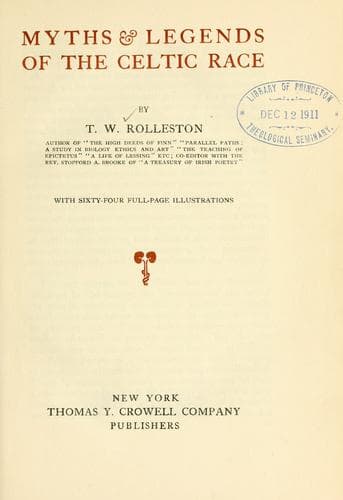
Myths & Legends of the Celtic RaceRolleston, T. W. (Thomas William)
Religion
Myths & Legends of the Celtic Race
Rolleston, T. W. (Thomas William)
Celts -- Religion; Mythology, Celtic
One of the most notable landmarks of Ireland was the _Tonn Cliodhna_, or
“Wave of Cleena,” on the seashore at Glandore Bay, in Co. Cork. The story
about Cleena exists in several versions, which do not agree with each
other except in so far as she seems to have been a Danaan maiden once
living in Mananan’s country, the Land of Youth beyond the sea. Escaping
thence with a mortal lover, as one of the versions tells, she landed on
the southern coast of Ireland, and her lover, Keevan of the Curling Locks,
went off to hunt in the woods. Cleena, who remained on the beach, was
lulled to sleep by fairy music played by a minstrel of Mananan, when a
great wave of the sea swept up and carried her back to Fairyland, leaving
her lover desolate. Hence the place was called the Strand of Cleena’s
Wave.
*The Goddess Ainé*
Another topical goddess was Ainé, the patroness of Munster, who is still
venerated by the people of that county. She was the daughter of the Danaan
Owel, a foster-son of Mananan and a Druid. She is in some sort a
love-goddess, continually inspiring mortals with passion. She was
ravished, it was said, by Ailill Olum, King of Munster, who was slain in
consequence by her magic arts, and the story is repeated in far later
times about another mortal lover, who was not, however, slain, a
Fitzgerald, to whom she bore the famous wizard Earl.(100) Many of the
aristocratic families of Munster claimed descent from this union. Her name
still clings to the “Hill of Ainé” (Knockainey), near Loch Gur, in
Munster. All the Danaan deities in the popular imagination were
earth-gods, _dei terreni_, associated with ideas of fertility and
increase. Ainé is not heard much of in the bardic literature, but she is
very prominent in the folk-lore of the neighbourhood. At the bidding of
her son, Earl Gerald, she planted all Knockainey with pease in a single
night. She was, and perhaps still is, worshipped on Midsummer Eve by the
peasantry, who carried torches of hay and straw, tied on poles and
lighted, round her hill at night. Afterwards they dispersed themselves
among their cultivated fields and pastures, waving the torches over the
crops and the cattle to bring luck and increase for the following year. On
one night, as told by Mr. D. Fitzgerald,(101) who has collected the local
traditions about her, the ceremony was omitted owing to the death of one
of the neighbours. Yet the peasantry at night saw the torches in greater
number than ever circling the hill, and Ainé herself in front, directing
and ordering the procession.
Public-domain text, read in full here on John Shaqi.
Reviews
Reviews
No reviews yet
Be the first to share your thoughts on this work.
Elsewhere in the archive
Join the Discussion
Join the discussion
Sign in to leave a comment or review.
Sign InorCreate an account