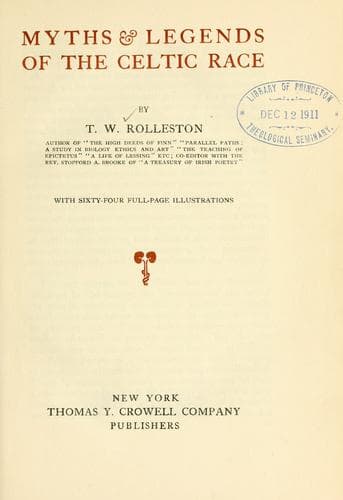
Myths & Legends of the Celtic RaceRolleston, T. W. (Thomas William)
Religion
Myths & Legends of the Celtic Race
Rolleston, T. W. (Thomas William)
Celts -- Religion; Mythology, Celtic
A great battle with the Danaans at Telltown(109) then follows. The three
kings and three queens of the Danaans, with many of their people, are
slain, and the children of Miled—the last of the mythical invaders of
Ireland—enter upon the sovranty of Ireland. But the People of Dana do not
withdraw. By their magic art they cast over themselves a veil of
invisibility, which they can put on or off as they choose. There are two
Irelands henceforward, the spiritual and the earthly. The Danaans dwell in
the spiritual Ireland, which is portioned out among them by their great
overlord, the Dagda. Where the human eye can see but green mounds and
ramparts, the relics of ruined fortresses or sepulchres, there rise the
fairy palaces of the defeated divinities; there they hold their revels in
eternal sunshine, nourished by the magic meat and ale that give them
undying youth and beauty; and thence they come forth at times to mingle
with mortal men in love or in war. The ancient mythical literature
conceives them as heroic and splendid in strength and beauty. In later
times, and as Christian influences grew stronger, they dwindle into
fairies, the People of the Sidhe;(110) but they have never wholly
perished; to this day the Land of Youth and its inhabitants live in the
imagination of the Irish peasant.
*The Meaning of the Danaan Myth*
All myths constructed by a primitive people are symbols, and if we can
discover what it is that they symbolise we have a valuable clue to the
spiritual character, and sometimes even to the history, of the people from
whom they sprang. Now the meaning of the Danaan myth as it appears in the
bardic literature, though it has undergone much distortion before it
reached us, is perfectly clear. The Danaans represent the Celtic reverence
for science, poetry, and artistic skill, blended, of course, with the
earlier conception of the divinity of the powers of Light. In their combat
with the Firbolgs the victory of the intellect over dulness and ignorance
is plainly portrayed—the comparison of the heavy, blunt weapon of the
Firbolgs with the light and penetrating spears of the People of Dana is an
indication which it is impossible to mistake. Again, in their struggle
with a far more powerful and dangerous enemy, the Fomorians, we are
evidently to see the combat of the powers of Light with evil of a more
positive kind than that represented by the Firbolgs. The Fomorians stand
not for mere dulness or stupidity, but for the forces of tyranny, cruelty,
and greed—for moral rather than for intellectual darkness.
*The Meaning of the Milesian Myth*
Public-domain text, read in full here on John Shaqi.
Reviews
Reviews
No reviews yet
Be the first to share your thoughts on this work.
Elsewhere in the archive
Join the Discussion
Join the discussion
Sign in to leave a comment or review.
Sign InorCreate an account