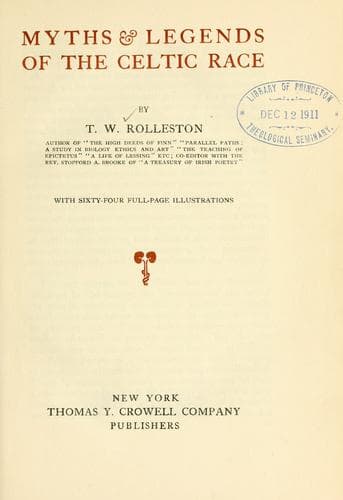
Myths & Legends of the Celtic RaceRolleston, T. W. (Thomas William)
Religion
Myths & Legends of the Celtic Race
Rolleston, T. W. (Thomas William)
Celts -- Religion; Mythology, Celtic
But the myth of the struggle of the Danaans with the sons of Miled is more
difficult to interpret. How does it come that the lords of light and
beauty, wielding all the powers of thought (represented by magic and
sorcery), succumbed to a human race, and were dispossessed by them of
their hard-won inheritance? What is the meaning of this shrinking of their
powers which at once took place when the Milesians came on the scene? The
Milesians were not on the side of the powers of darkness. They were guided
by Amergin, a clear embodiment of the idea of poetry and thought. They
were regarded with the utmost veneration, and the dominant families of
Ireland all traced their descent to them. Was the Kingdom of Light, then,
divided against itself? Or, if not, to what conception in the Irish mind
are we to trace the myth of the Milesian invasion and victory?
The only answer I can see to this puzzling question is to suppose that the
Milesian myth originated at a much later time than the others, and was, in
its main features, the product of Christian influences. The People of Dana
were in possession of the country, but they were pagan divinities—they
could not stand for the progenitors of a Christian Ireland. They had
somehow or other to be got rid of, and a race of less embarrassing
antecedents substituted for them. So the Milesians were fetched from
“Spain” and endowed with the main characteristics, only more humanised, of
the People of Dana. But the latter, in contradistinction to the usual
attitude of early Christianity, are treated very tenderly in the story of
their overthrow. One of them has the honour of giving her name to the
island, the brutality of one of the conquerors towards them is punished
with death, and while dispossessed of the lordship of the soil they still
enjoy life in the fair world which by their magic art they have made
invisible to mortals. They are no longer gods, but they are more than
human, and frequent instances occur in which they are shown as coming
forth from their fairy world, being embraced in the Christian fold, and
entering into heavenly bliss. With two cases of this redemption of the
Danaans we shall close this chapter on the Invasion Myths of Ireland.
The first is the strange and beautiful tale of the Transformation of the
Children of Lir.
*The Children of Lir*
Lir was a Danaan divinity, the father of the sea-god Mananan who
continually occurs in magical tales of the Milesian cycle. He had married
in succession two sisters, the second of whom was named Aoife.(111) She
was childless, but the former wife of Lir had left him four children, a
girl named Fionuala(112) and three boys. The intense love of Lir for the
children made the stepmother jealous, and she ultimately resolved on their
destruction. It will be observed, by the way, that the People of Dana,
though conceived as unaffected by time, and naturally immortal, are
nevertheless subject to violent death either at the hands of each other or
even of mortals.
Public-domain text, read in full here on John Shaqi.
Reviews
Reviews
No reviews yet
Be the first to share your thoughts on this work.
Elsewhere in the archive
Join the Discussion
Join the discussion
Sign in to leave a comment or review.
Sign InorCreate an account