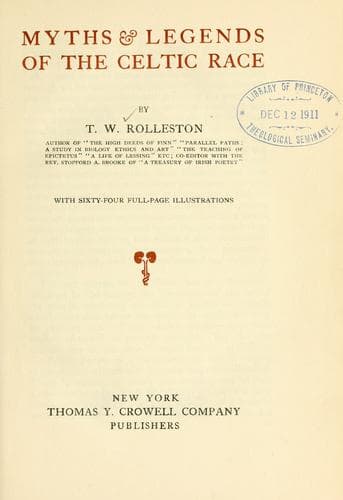
Myths & Legends of the Celtic RaceRolleston, T. W. (Thomas William)
Religion
Myths & Legends of the Celtic Race
Rolleston, T. W. (Thomas William)
Celts -- Religion; Mythology, Celtic
The kings and heroes of the Milesian race now fill the foreground of the
stage in Irish legendary history. But, as we have indicated, the Danaan
divinities are by no means forgotten. The fairyland in which they dwell is
ordinarily inaccessible to mortals, yet it is ever near at hand; the
invisible barriers may be, and often are, crossed by mortal men, and the
Danaans themselves frequently come forth from them; mortals may win brides
of Faëry who mysteriously leave them after a while, and women bear
glorious children of supernatural fatherhood. Yet whatever the Danaans may
have been in the original pre-Christian conceptions of the Celtic Irish,
it would be a mistake to suppose that they figure in the legends, as these
have now come down to us, in the light of gods as we understand this term.
They are for the most part radiantly beautiful, they are immortal (with
limitations), and they wield mysterious powers of sorcery and enchantment.
But no sort of moral governance of the world is ever for a moment ascribed
to them, nor (in the bardic literature) is any act of worship paid to
them. They do not die naturally, but they can be slain both by each other
and by mortals, and on the whole the mortal race is the stronger. Their
strength when they come into conflict (as frequently happens) with men
lies in stratagem and illusion; when the issue can be fairly knit between
the rival powers it is the human that conquers. The early kings and heroes
of the Milesian race are, indeed, often represented as so mightily endowed
with supernatural power that it is impossible to draw a clear distinction
between them and the People of Dana in this respect. The Danaans are much
nobler and more exalted beings, as they figure in the bardic literature,
than the fairies into which they ultimately degenerated in the popular
imagination; they may be said to hold a position intermediate between
these and the Greek deities as portrayed in Homer. But the true worship of
the Celts, in Ireland as elsewhere, seems to have been paid, not to these
poetical personifications of their ideals of power and beauty, but rather
to elemental forces represented by actual natural phenomena—rocks, rivers,
the sun, the wind, the sea. The most binding of oaths was to swear by the
Wind and Sun, or to invoke some other power of nature; no name of any
Danaan divinity occurs in an Irish oath formula. When, however, in the
later stages of the bardic literature, and still more in the popular
conceptions, the Danaan deities had begun to sink into fairies, we find
rising into prominence a character probably older than that ascribed to
them in the literature, and, in a way, more august. In the literature it
is evident that they were originally representatives of science and
poetry—the intellectual powers of man. But in the popular mind they
represented, probably at all times and certainly in later Christian times,
not intellectual powers, but those associated with the fecundity of earth.
Public-domain text, read in full here on John Shaqi.
Reviews
Reviews
No reviews yet
Be the first to share your thoughts on this work.
Elsewhere in the archive
Join the Discussion
Join the discussion
Sign in to leave a comment or review.
Sign InorCreate an account