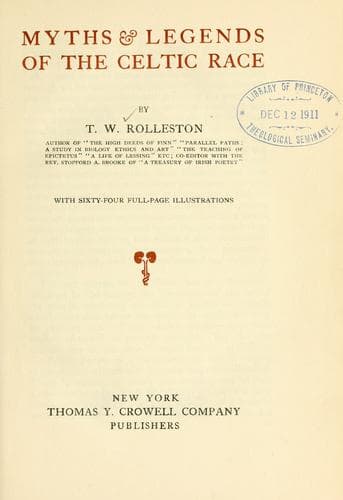
Myths & Legends of the Celtic RaceRolleston, T. W. (Thomas William)
Religion
Myths & Legends of the Celtic Race
Rolleston, T. W. (Thomas William)
Celts -- Religion; Mythology, Celtic
They were, as a passage in the Book of Armagh names them, _dei terreni_,
earth-gods, and were, and are still, invoked by the peasantry to yield
increase and fertility. The literary conception of them is plainly Druidic
in origin, the other popular; and the popular and doubtless older
conception has proved the more enduring.
But these features of Irish mythology will appear better in the actual
tales than in any critical discussion of them; and to the tales let us now
return.
*The Milesian Settlement of Ireland*
The Milesians had three leaders when they set out for the conquest of
Ireland—Eber Donn (Brown Eber), Eber Finn (Fair Eber), and Eremon. Of
these the first-named, as we have seen, was not allowed to enter the
land—he perished as a punishment for his brutality. When the victory over
the Danaans was secure the two remaining brothers turned to the Druid
Amergin for a judgment as to their respective titles to the sovranty.
Eremon was the elder of the two, but Eber refused to submit to him. Thus
Irish history begins, alas! with dissension and jealousy. Amergin decided
that the land should belong to Eremon for his life, and pass to Eber after
his death. But Eber refused to submit to the award, and demanded an
immediate partition of the new-won territory. This was agreed to, and Eber
took the southern half of Ireland, “from the Boyne to the Wave of
Cleena,”(115) while Eremon occupied the north. But even so the brethren
could not be at peace, and after a short while war broke out between them.
Eber was slain, and Eremon became sole King of Ireland, which he ruled
from Tara, the traditional seat of that central authority which was always
a dream of the Irish mind, but never a reality of Irish history.
*Tiernmas and Crom Cruach*
Of the kings who succeeded Eremon, and the battles they fought and the
forests they cleared away and the rivers and lakes that broke out in their
reign, there is little of note to record till we come to the reign of
Tiernmas, fifth in succession from Eremon. He is said to have introduced
into Ireland the worship of Crom Cruach, on Moyslaught (The Plain of
Adoration(116)), and to have perished himself with three-fourths of his
people while worshipping this idol on November Eve, the period when the
reign of winter was inaugurated. Crom Cruach was no doubt a solar deity,
but no figure at all resembling him can be identified among the Danaan
divinities. Tiernmas also, it is said, found the first gold-mine in
Ireland, and introduced variegated colours into the clothing of the
people. A slave might wear but one colour, a peasant two, a soldier three,
a wealthy landowner four, a provincial chief five, and an Ollav, or royal
person, six. Ollav was a term applied to a certain Druidic rank; it meant
much the same as “doctor,” in the sense of a learned man—a master of
science. It is a characteristic trait that the Ollav is endowed with a
distinction equal to that of a king.
*Ollav Fōla*
Public-domain text, read in full here on John Shaqi.
Reviews
Reviews
No reviews yet
Be the first to share your thoughts on this work.
Elsewhere in the archive
Join the Discussion
Join the discussion
Sign in to leave a comment or review.
Sign InorCreate an account