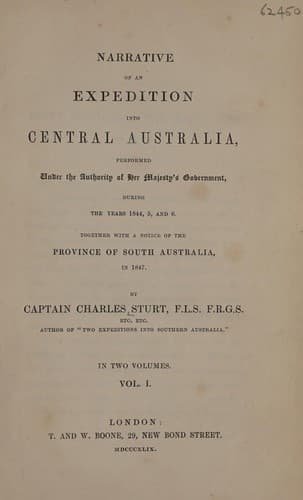
Narrative of an Expedition into Central Australia: Performed Under the Authority of Her Majesty's Government, During the Years 1844, 5, and 6, Together With A Notice of the Province of South Australia in 1847Sturt, Charles
History
Narrative of an Expedition into Central Australia: Performed Under the Authority of Her Majesty's Government, During the Years 1844, 5, and 6, Together With A Notice of the Province of South Australia in 1847
Sturt, Charles
Central Australia -- Discovery and exploration; Natural history -- Australia -- Central Australia; South Australia -- Description and travel
The Australian continent is not distinguished, as are many other
continents of equal and even of less extent, by any prominent
geographical feature. Its mountains seldom exceed four thousand feet in
elevation, nor do any of its rivers, whether falling internally or
externally, not even the Murray, bear any proportion to the size of the
continent itself. There is no reason, however, why rivers of greater
magnitude, than any which have hitherto been discovered in it, should not
emanate from mountains of such limited altitude, as the known mountains
of that immense and sea-girt territory. But, it appears to me, it is not
in the height and character of its hilly regions, that we are to look for
the causes why so few living streams issue from them. The true cause, I
apprehend, lies in its climate, in its seldom experiencing other than
partial rains, and in its being subject to severe and long continued
droughts. Its streams descend rapidly into a country of uniform equality
of surface, and into a region of intense heat, and are subject, even at a
great distance from their sources, to sudden and terrific floods, which
subside, as the cause which gave rise to them ceases to operate; the
consequence is, that their springs become gradually weaker and weaker,
all back impulse is lost, and whilst the rivers still continue to support
a feeble current in the hills, they cease to flow in their lower
branches, assume the character of a chain of ponds, in a few short weeks
their deepest pools are exhausted by the joint effects of evaporation and
absorption, and the traveller may run down their beds for miles, without
finding a drop of water with which to slake his thirst.
In illustration of the above, I would observe that during the progress of
the recent expedition up the banks of the Darling, and at a distance of
more than 300 miles from its sources, that river rose from a state of
complete exhaustion, until in four days it overflowed its banks. It was
converted in a single night, from an almost dry channel, into a foaming
and impetuous stream, rolling along its irresistible and turbid waters,
to add to those of the Murray.
There can be no doubt, but, that this sudden rise in the river, was
caused by heavy rains on the mountains, in which its tributaries are to
be found, for the Darling does not receive any accession to its waters
below their respective junctions, of sufficient magnitude to account for
such an occurrence. [Note 1. below]
[Note 1. The principal tributaries of the Darling, are the Kindur, the
Keraula, the Namoy, and the Gwydir. They are beautiful mountain streams,
and rise in the hilly country, behind Moreton Bay, in lat. 27 degrees,
and in longitude 152 degrees E.]
Reviews
Reviews
No reviews yet
Be the first to share your thoughts on this work.
Join the Discussion
Join the discussion
Sign in to leave a comment or review.
Sign InorCreate an account