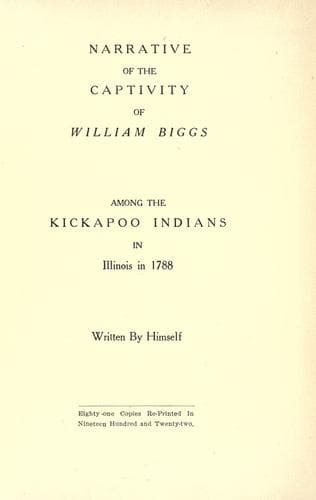
Narrative of the Captivity of William Biggs among the Kickapoo Indians in Illinois in 1788Biggs, William
History
Narrative of the Captivity of William Biggs among the Kickapoo Indians in Illinois in 1788
Biggs, William
Indian captivities; Kickapoo Indians
beaver macaroni hat. These they had taken from some officers they had
killed. Then the widow squaw took me into her cabin and gave me a new
ruffled shirt and a very good blanket. They told me to put them on; I
did so. When I had got my fine dress on, the funny Indian told me to
walk across the floor. I knew they wanted to have a little fun. I put my
arms akimbo with my hands on my hips, and walked with a very proud air
three or four times backwards and forwards across the floor. The funny
Indian said in Indian that I was a very handsome man and a big captain.
I then sat down, and they viewed me very much, and said I had a very
handsome leg and thigh, and began to tell how fast I ran when the
Indians caught me, and showed how I ran--like a bird flying. They
appeared to be very well pleased with me, and I felt as comfortable as
the nature of the case would admit of.
The next morning after breakfast, they all left that camp; they put all
their property into a large perouge and moved by water up the Wabash
river to the old Kickapoo trading town, about ten miles from their sugar
camp; they sent me by land and one Indian with me. When we had got about
half way to the town, we met with a young Frenchman; his name was Ebart;
I was very well acquainted with him in the Illinois country; he spoke
tolerably good English. The Indian then left me, and I went on to the
town with the young Frenchman; I got to the town before the Indians
arrived with their perouge, and the young Frenchman showed me their
cabin, and told me to stay there until they would come, that they would
be there in a few minutes. I there met with an English trader, a very
friendly man, whose name was John McCauslin; he was from the north of
England; we made some little acquaintance. He was a Freemason and
appeared very sorry for my misfortune and told me he would do everything
in his power to befriend me and told me I was with good Indians, they
would not hurt me. He inquired of me where I lived and asked if I had a
family. He then told me of the circumstance of the Indians killing one
of their own men that day they caught me. He said it was a fact, he was
a bad Indian and would not obey the commands of his captain and that he
was still determined to kill me. My Indian family soon arrived and
cleared up their cabin and got their family ready. They were a smart,
neat and cleanly family, kept their cabin very nice and clean, the same
as white women, and cooked their victuals very nice. After dinner was
over, there came four Indians in the old chief's cabin. Two of them were
the old chief's brother's children. They appeared to be in a very fine
humor. I did not know but that they belonged to the same family and
town. They had not been there more than one hour, until the old chief
and the four Indians sat down on the floor in the cabin and had a long
discourse about an hour and a half. Then all got up. The old chief then
told me I must go with those Indians. I told him I did not want to go.
Public-domain text, read in full here on John Shaqi.
Reviews
Reviews
No reviews yet
Be the first to share your thoughts on this work.
Join the Discussion
Join the discussion
Sign in to leave a comment or review.
Sign InorCreate an account