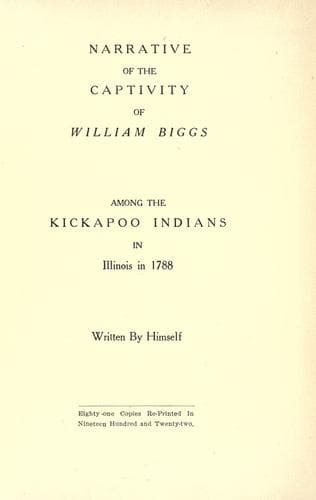
Narrative of the Captivity of William Biggs among the Kickapoo Indians in Illinois in 1788Biggs, William
History
Narrative of the Captivity of William Biggs among the Kickapoo Indians in Illinois in 1788
Biggs, William
Indian captivities; Kickapoo Indians
These Indians lived about six miles west of the old Kickapoo trading
town, on the west side of the Wabash river. They had no traders in their
town. After dinner was over, they told the interpreter Coons that I must
write to their trading town for some bread. I told Coons to tell them I
had nothing to write with--no paper, nor pen and ink. They said I must
write. I told Coons to tell them again I had no paper nor nothing to
write with. Coons told them. Then the Indian that claimed me went to his
trunk and brought me a letter that had one-half sheet of it clean paper.
I told Coons to tell them I wanted a pen. The same Indian went and
pulled a quill out of a turkey wing and gave it to me. I told Coons I
wanted a knife to make the pen. The same Indian got his scalping knife;
he gave it two or three little whets and gave it to me. I then told
Coons I wanted some ink. Coons says, "Ink--ink; what is tat? I ton't
know what ink is." He had no name for ink in Indian or English. I told
him to tell the Indian to get me some gunpowder and water and a spoon
and I would make the ink myself. The Indian did so. I knew very well
what their drift was; they wanted a proof to know whether I told them
any lies when they examined me in their council. When I had made the ink
and was ready to write I asked Coons how many loaves of bread I should
write for. He says, "Ho! a couple of lofes; tay only want to know if you
can write or if you told them any lies or not." I wrote to the English
trader, that I mentioned before that I had made some acquaintance with
the day I passed the old trading town, for to get me two loaves of
bread. He very well knew my situation and circumstances. There was a
Frenchman, a baker, that lived in the trading town.
When I had finished writing, the Indian took it up and looked at it and
said, "Depaway, vely good." Coons' master, a brother to the one that
claimed me, told Coons to go catch his horse and take the letter for the
bread, not stay, but return as soon as possible. Coons hurried off
immediately and soon returned. As soon as he came back he brought the
two loaves of bread and gave them to me. I then asked Coons what I
should do with this bread, as he was somewhat better acquainted with the
ways of the Indians than I was. He says, "Kife one loaf to tay old squaw
and her two little chiltren, and tofide the otter loaf petween you and
your master, put keep a pigest half." I did so. This old squaw was the
mother of the two Indians that claimed Coons and myself. The old squaw
and her two children soon eat their loaf. I then divided my half between
the two little children again. That pleased the old squaw very much; she
tried to make me sensible of her thanks for my kindness to her two
little children.
Public-domain text, read in full here on John Shaqi.
Reviews
Reviews
No reviews yet
Be the first to share your thoughts on this work.
Join the Discussion
Join the discussion
Sign in to leave a comment or review.
Sign InorCreate an account