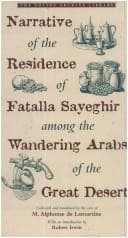
Narrative of the residence of Fatalla Sayeghir among the wandering Arabs of the great desertLamartine, Alphonse de
History
Narrative of the residence of Fatalla Sayeghir among the wandering Arabs of the great desert
Lamartine, Alphonse de
Arabian Peninsula -- Description and travel
The more I have travelled, the more I am convinced that races of men
form the great secret of history and manners. Man is not so capable of
education as philosophers imagine. The influence of governments and
laws has less power, radically, than is supposed, over the manners
and instincts of any people, while the primitive constitution and the
blood of the race have always their influence, and manifest themselves,
thousands of years afterwards, in the physical formations and moral
habits of a particular family or tribe. Human nature flows in rivers
and streams into the vast ocean of humanity: but its waters mingle but
slowly, sometimes never; and it emerges again, like the Rhone from
the Lake of Geneva, with its own taste and colour. Here is indeed an
abyss of thought and meditation, and at the same time a grand secret
for legislators. As long as they keep the spirit of race in view,
they succeed; but they fail when they strive against this natural
predisposition: nature is stronger than they are. This sentiment is
not that of the philosophers of the present time, but it is evident
to the traveller; and there is more philosophy to be found in a
caravan journey of a hundred leagues, than in ten years’ reading and
meditation. I felt happy in thus wandering about among deserts and
unknown countries, with no route before me but my caprice; and I told
my friends, and M. Mazolier, my interpreter, that if I were alone and
without family ties, I would lead this manner of life for years and
years. I would never sleep where I had arisen: I would transport my
tent from the shores of Egypt to the Persian Gulf, and wish no aim for
the evening but evening itself. I would wander on foot, and dwell with
eye and heart on these unknown lands, these races of men so different
from my own, and contemplate humanity, this most beautiful work of
God, under all its forms. To effect this, what would be requisite?--a
few slaves or faithful servants, arms, a little gold, two or three
tents, and some camels. The sky of these countries is almost always
warm and pure, life easy and economical, and hospitality certain and
picturesque. I should prefer, a hundred times, years passed under
different skies, with hosts and friends ever new, to the barren and
noisy monotony of the life of our capitals. It is undoubtedly more
difficult to lead the life of a man of the world in Paris or London,
than to visit the universe as a traveller. The results of two such
lives are, however, very different. The traveller either dies, or
he returns with a treasure of thoughts and wisdom. The domesticated
inhabitant of our capitals grows old without knowledge, without
experience, and dies as much entrammelled, as much immersed in false
notions, as when he first begins to exercise his senses. I should like,
said I to my dragoman, to cross those mountains, to descend into the
great desert of Syria, accost some of the large unknown tribes that
Public-domain text, read in full here on John Shaqi.
Reviews
Reviews
No reviews yet
Be the first to share your thoughts on this work.
Join the Discussion
Join the discussion
Sign in to leave a comment or review.
Sign InorCreate an account