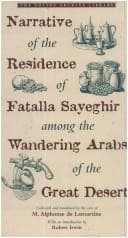
Narrative of the residence of Fatalla Sayeghir among the wandering Arabs of the great desertLamartine, Alphonse de
History
Narrative of the residence of Fatalla Sayeghir among the wandering Arabs of the great desert
Lamartine, Alphonse de
Arabian Peninsula -- Description and travel
The following day, having hired a house, we unpacked our goods. I
attended to the foot of Sheik Ibrahim, which was in reality dislocated.
He had long to suffer the pain. Hassan found friends at Palmyra who
took care of him; and being soon recovered, he came to take leave of
us, and went away delighted with the manner in which we recompensed him.
Being obliged to keep at home for several days on account of Sheik
Ibrahim’s foot, we set about selling some articles, to confirm our
mercantile character. But as soon as M. Lascaris was in a fit state to
walk, we went to visit the temple in all its minutiæ. Other travellers
have described the ruins: therefore we will only speak of what may have
escaped their observation relating to the country.
We one day saw many people engaged in surrounding with wood a
beautiful granite column. We were told it was to burn it, or rather
to cause it to fall, in order to obtain the lead which was in the
joinings. Sheik Ibrahim, full of indignation, addressing me, exclaimed,
“What would the founders of Palmyra say if they beheld these barbarians
thus destroying their work? Since chance has brought me hither, I
will oppose this act of Vandalism.” And having learned what might be
the worth of the lead, he gave the fifty piastres they asked, and the
column became our property. It was of the most beautiful red granite,
spotted with blue and black, sixty-two feet in length, and ten in
circumference. The Palmyrians, perceiving our taste for monuments,
pointed out to us a curious spot, an hour and a half distant, in which
the columns were formerly cut, and where there are still some beautiful
fragments. For ten piastres three Arabs agreed to take us there. The
road is strewed with very beautiful ruins, described, I presume, by
other travellers. We observed a grotto, in which was a beautiful white
marble column cut and chiselled, and another only half finished. One
might say that Time, the destroyer of so much magnificence, was wanting
to place up the first, and to finish the second.
After having been into several grottoes, and visited the neighbourhood,
we came back by another road. Our guides pointed out a beautiful
spring, covered with blocks of stone. It is called Ain Ournus. The name
struck Sheik Ibrahim. At last, calling me, he said: “I have discovered
what this name Ournus means. Aurelianus, the Roman emperor, came to
besiege Palmyra and take possession of its riches. It is he probably
who dug this well for the wants of his army during the siege, and the
spring may have taken his name, changed by the lapse of time into
Ournus.” According to my feeble knowledge of history, Sheik Ibrahim’s
conjecture is not without foundation.
Public-domain text, read in full here on John Shaqi.
Reviews
Reviews
No reviews yet
Be the first to share your thoughts on this work.
Join the Discussion
Join the discussion
Sign in to leave a comment or review.
Sign InorCreate an account