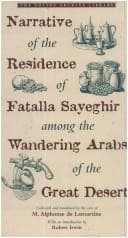
Narrative of the residence of Fatalla Sayeghir among the wandering Arabs of the great desertLamartine, Alphonse de
History
Narrative of the residence of Fatalla Sayeghir among the wandering Arabs of the great desert
Lamartine, Alphonse de
Arabian Peninsula -- Description and travel
thousand piastres. All the Bedouins participated in his affliction,
and the Drayhy gave him one of his best horses, very inferior however
to the superb animal he had lost. The next day the battle was renewed
with increased fury, and our loss was more considerable than that of
the enemy. We were obliged to act with extreme caution, having only
fifteen thousand troops to oppose to him. Forty of our men fell into
their hands, while we made only fifteen prisoners; but amongst these
was Hamed, son of the chief Saker. The captives on both sides were put
in irons.
To these two days of fighting succeeded a tacit truce of three,
during which the two armies continued to face each other without any
demonstration of hostility. On the third day, the chief Saker, with
a single attendant, came to our camp. He was uneasy for his son, a
valiant young man, adored by his father and by all the Bedouins of his
tribe; and he came to ransom him. Hamed had been very well treated by
us; I had myself bound up his wounds. The Drayhy received Saker with
great distinction. The latter, after the customary civilities, spoke of
the war--expressed his astonishment at the Drayhy’s ardour against the
Wahabees, and said that he could not credit so much disinterestedness,
under which some secret motives or personal views must needs be
couched. “You cannot take it ill,” added he, “that I do not engage with
you without knowing your object. Take me into your confidence, and I
will second you to the utmost of my power.” We replied, that we were
not in the habit of admitting to our secrets those of whose friendship
we had no assurance; but that if he chose to sign our treaty, we should
have no concealments from him. He then asked to be made acquainted
with this engagement, and after having listened to a lecture of the
different articles, with which he seemed to be very well content,
he assured us that things had been very differently represented to
him, and repeated the calumnies that Absi had spread concerning us.
He ended by affixing his seal to the treaty, and afterwards pressed
us to explain the object we were aiming at. Sheik Ibrahim told him
that our intention was to open a passage from the coasts of Syria to
the frontiers of India, to an army of a hundred thousand men, under a
powerful conqueror, who would relieve the Bedouins from the yoke of the
Turks, restore to them the sovereignty of the country, and enable them
to obtain possession of the treasures of India. He affirmed that there
was nothing to be lost, but every thing to gain, in the execution of
this project, the success of which depended upon the union of forces
and the harmony of inclinations. He promised that their camels should
be paid at a high price for the transport of the provisions for this
great army, and made him look to the commerce of these vast countries
as likely to become a source of inexhaustible riches to them.
Public-domain text, read in full here on John Shaqi.
Reviews
Reviews
No reviews yet
Be the first to share your thoughts on this work.
Elsewhere in the archive
Join the Discussion
Join the discussion
Sign in to leave a comment or review.
Sign InorCreate an account