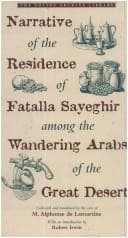
Narrative of the residence of Fatalla Sayeghir among the wandering Arabs of the great desertLamartine, Alphonse de
History
Narrative of the residence of Fatalla Sayeghir among the wandering Arabs of the great desert
Lamartine, Alphonse de
Arabian Peninsula -- Description and travel
Sheik Ibrahim proposed to send me to them with presents, to endeavour
to come to an explanation. My embassies had hitherto succeeded so
well, that I accepted this with pleasure, and set out with a single
guide: but scarcely had we reached the tent of Mohdi, who lay nearest
to us, when their advanced guard came upon us like wild beasts, robbed
us of our presents and our clothes, put irons on our feet, and left us
naked on the burning sands. In vain I entreated permission to explain;
I was threatened with instant death if I persisted in remonstrating.
Some moments afterwards, I saw the perfidious Absi advancing to me:
I then understood the cause of the inconceivable treatment of which
I had been the victim; he had been travelling from tribe to tribe to
raise enemies against us. I was so enraged at the sight of him, that
my fallen courage revived, and I determined to die bravely if I could
not live to take vengeance. He approached, and, spitting in my face,
cried, “Dog of an infidel! in what manner do you choose that I should
separate your soul from your body?”--“My soul,” I replied, “is not in
your power; my days are numbered by the great God: if they are to end
now, it signifies little in what manner; but if I am still to live,
you have no power to kill me.” He then withdrew to excite the Bedouins
against me afresh, and men, women, and children came to overwhelm me
with outrages: some spit in my face, others threw sand in my eyes;
several pricked me with their djerids. I was kept twenty-four hours
without eating or drinking, and suffering a martyrdom it is impossible
to describe. Towards the evening of the second day, a young man, named
labour, came to me, and drove away the children who were tormenting
me. I had already remarked him; for, of all those I had seen during
this day, he alone had not insulted me. He offered to bring me bread
and water at nightfall. “Hunger and thirst,” I replied, thanking him,
“are of little consequence; but if you could assist me to escape hence,
I would reward you generously.” He promised to attempt it, and in the
middle of the night brought me the key of my fetters, which he had
had the address to procure while the chiefs were at supper. He opened
them without noise; and without taking time to throw on my clothes,
we ran back to my tribe. All were asleep in the camp, except the four
negroes who kept guard at the entrance of Drayhy’s tent: they uttered a
cry on seeing me, and in great haste woke their master, who came with
Sheik Ibrahim: they embraced me with tears, and handsomely rewarded my
liberator. The Drayhy expressed the most lively grief at the treatment
I had experienced, and the greatest indignation at this violation of
the rights of nations. He immediately gave orders for battle, and at
sunrise we perceived that the enemy had done the same. On the first
day, there was no marked advantage on either side. Auad, chief of the
tribe Suallema, lost his mare, for which he had refused twenty-five
Public-domain text, read in full here on John Shaqi.
Reviews
Reviews
No reviews yet
Be the first to share your thoughts on this work.
Elsewhere in the archive
Join the Discussion
Join the discussion
Sign in to leave a comment or review.
Sign InorCreate an account