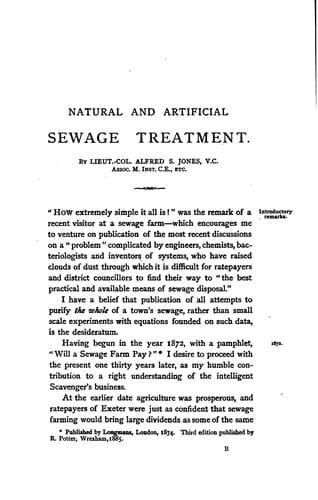
Natural & Artificial Sewage TreatmentJones, Alfred Stowell
Science
Natural & Artificial Sewage Treatment
Jones, Alfred Stowell
Sewage
Directing now attention to the practical side of the question, it has
already been stated that the only known sewage treatment at the
commencement of last century was land irrigation. Then about the
middle of the century chemistry seems to have taken the matter in hand
and tried to make a lucrative business out of it. It is on record,
however, that it did not succeed in this attempt, and the financial
loss which this endeavour has caused is a dismal subject to
investigate.
There is before my mind’s eye the case of a gallant officer of His
Majesty’s land forces who, after having reached very near the summit
of his career, retired and employed his time in trying to make a
fortune out of sewage. So enamoured was he of the subject, that—so the
story goes—he commuted his pension to have all the more ready money;
but fortune did not smile on him, and his last days were spent under
the lengthening shadows of the sorrow of financial difficulties,
having practically lost all he possessed.
The emphatic verdict of the first Sewage Commission of 1857, the first
and second Rivers Pollution Commission, and, indeed, of all other
authoritative investigations, was in favour of land treatment; and it
cannot, therefore, be surprising to find that the Local Government
Board insisted, save in exceptional cases, that “any scheme of sewage
disposal, for which money is to be borrowed with their sanction,
should provide for the application of the sewage or effluent to an
adequate area of suitable land before it is discharged into a stream.”
Indeed, had this body taken any different view and neglected the
findings of practically all authoritative inquiries, it would have
been singularly deficient in the discharge of its duties to the
ratepayers of this country.
But the best of land cannot go on for ever doing its duty if by
systematic neglect and ignorance the essential conditions for
successful purification are year after year violated; and the great
pity is that the Local Government Board, after deciding in favour of
land treatment, did not systematically superintend this operation. It
may not have had the power, but it is quite evident that had it done
so, things would not have drifted from bad to worse, until local
authorities, driven to despair by the apparent failure of land and not
discerning the right cause, refused altogether to be ruled by what
seemed to them a very unfair and absurd restriction.
Public-domain text, read in full here on John Shaqi.
Reviews
Reviews
No reviews yet
Be the first to share your thoughts on this work.
Join the Discussion
Join the discussion
Sign in to leave a comment or review.
Sign InorCreate an account