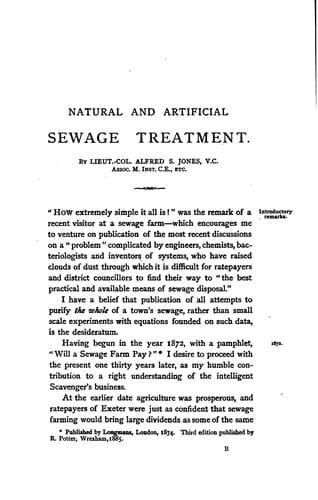
Natural & Artificial Sewage TreatmentJones, Alfred Stowell
Science
Natural & Artificial Sewage Treatment
Jones, Alfred Stowell
Sewage
If more sewage is poured upon the land than the effluent drains can
deal with—and here it may be well to bear in mind that on sewage farms
in our climate on a broad average throughout the year about one-third
of the total quantity is lost by evaporation—the excess will pass down
between the drains from the evaporation to the passage zone, and if
the flow of the sewage is not discontinued the downward movement in
the passage zone may be continued until, after having traversed the
capillary zone, the level of the subsoil water is reached.
[Sidenote: Length of downward movement of water may be very great.]
What length of time may elapse before this level is reached will
entirely depend on local circumstances, but it will be clear from the
preliminary remarks that the completion of this downward movement may
in places and under certain conditions take a very long time.
[Sidenote: Displacement of sewage held by the pores of the land by the
fresh discharge of sewage upon the surface of the land.]
In connection with this it is of importance to point out that not the
fresh sewage which is poured on the surface of the land will at once
pass into the lower layers, but a portion of the old sewage, which up
to then was stored in the pores and is now displaced by the fresh
discharge, so that the fresh raw sewage is retained and only purified
sewage allowed to escape into deeper layers, which means that in its
downward movement all sewage undergoes purification. Were this not the
case the raw sewage might reach the effluent drains.
It appears time now to examine somewhat more closely the processes of
decomposition and the products elaborated therein.
[Sidenote: Factors that influence the process of decomposition.]
Concerning the factors which have a favourable influence upon this
process, some of them, such as permeability for air, high retentive
and absorbing powers, have already been mentioned, and to these can be
added moisture and warmth, the latter of which are always present in
sewage.
[Sidenote: Advantages of a systematic underdrainage.]
One word here concerning the systematic under-drainage of the subsoil.
Its chief function is, of course, the carrying away of the effluent
water and by doing so to prevent the formation of a swamp, but after
the land has done its work, and during so-called periods of rest, the
under-drains act as ventilators of the subsoil and thus make it
artificially more permeable for air, with the result that a drying-up
action is set up and oxygen supplied for micro-organic life. For the
purpose of improving the ventilation of the soil it may become
advisable in places to connect the upper ends of the drains with a
short upcast shaft. The mouths of the drains should always discharge
above water so as to allow of a free circulation of air.
[Sidenote: Micro-organisms that carry on the work of splitting up and
converting organic compounds.]
Public-domain text, read in full here on John Shaqi.
Reviews
Reviews
No reviews yet
Be the first to share your thoughts on this work.
Join the Discussion
Join the discussion
Sign in to leave a comment or review.
Sign InorCreate an account