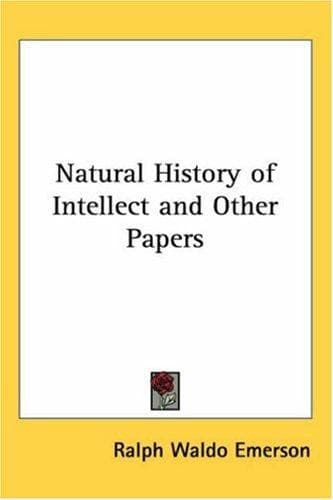
Natural history of intellect, and other papers — John Shaqi
Natural history of intellect, and other papersEmerson, Ralph Waldo
Philosophy
Natural history of intellect, and other papers
Emerson, Ralph Waldo
American essays -- 19th century; Boston (Mass.); Intellect; Memory; Michelangelo Buonarroti, 1475-1564; Milton, John, 1608-1674
I may well say this is divine, the continuation of the divine effort.
Alas! it seems not to be ours, to be quite independent of us. Often
there is so little affinity between the man and his works that we
think the wind must have writ them. Also its communication from one
to another follows its own law and refuses our intrusion. It is in
one, it belongs to all; yet how to impart it?
We need all our resources to live in the world which is to be used
and decorated by us. Socrates kept all his virtues as well as his
faculties well in hand. He was sincerely humble, but he utilized his
humanity chiefly as a better eyeglass to penetrate the vapors that
baffled the vision of other men.
* * * * *
The superiority of the man is in the simplicity of his thought, that
he has no obstruction, but looks straight at the pure fact, with no
color of option. Profound sincerity is the only basis of talent as of
character. The virtue of the Intellect is its own, its courage is of
its own kind, and at last it will be justified, though for the moment
it seem hostile to what it most reveres.
* * * * *
We wish to sum up the conflicting impressions by saying that all
point at last to a unity which inspires all. Our poetry, our religion
are its skirts and penumbræ. Yet the charm of life is the hints we
derive from this. They overcome us like perfumes from a far-off
shore of sweetness, and their meaning is that no tongue shall
syllable it without leave; that only itself can name it; that by
casting ourselves on it and being its voice it rushes each moment to
positive commands, creating men and methods, and ties the will of a
child to the love of the First Cause.
FOOTNOTES:
[1] 1850
MEMORY.
[Illustration: (decorative banner)]
MEMORY.
Memory is a primary and fundamental faculty, without which none other
can work; the cement, the bitumen, the matrix in which the other
faculties are imbedded; or it is the thread on which the beads of man
are strung, making the personal identity which is necessary to moral
action. Without it all life and thought were an unrelated succession.
As gravity holds matter from flying off into space, so memory gives
stability to knowledge; it is the cohesion which keeps things from
falling into a lump, or flowing in waves.
We like longevity, we like signs of riches and extent of nature in
an individual. And most of all we like a great memory. The lowest
life remembers. The sparrow, the ant, the worm, have the same memory
as we. If you bar their path, or offer them somewhat disagreeable
to their senses, they make one or two trials, and then once for all
avoid it.
Public-domain text, read in full here on John Shaqi.
Reviews
Reviews
No reviews yet
Be the first to share your thoughts on this work.
Join the Discussion
Join the discussion
Sign in to leave a comment or review.
Sign InorCreate an account