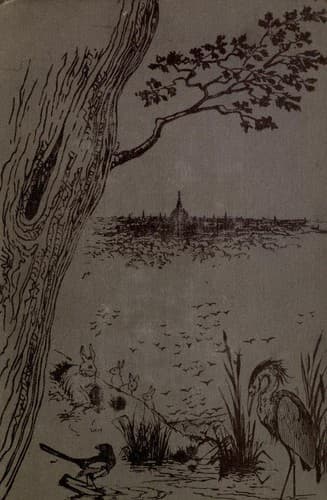
Country life -- England; Natural history -- Outdoor books; Nature study
That the fieldfares and redwings do so I can say with confidence,
because, as they move in large flocks, there is no difficulty in tracing
the direction in which they are going. They all went west when the
severe weather began. On the southern side of London, at least in the
districts I am best acquainted with, there was hardly a fieldfare or
redwing to be seen for weeks and even months. Towards spring they came
back, flying east for Norway. As thrushes and blackbirds move singly,
and not with concerted action, their motions cannot be determined with
such precision, but all the facts are in favour of the belief that they
also went west.
That they were killed by the frost and snow I utterly refuse to credit.
Some few, no doubt, were--I saw some greatly enfeebled by
starvation--but not the mass. If so many had been destroyed their bodies
must have been seen when there was no foliage to hide them, and no
insects to quickly play the scavenger as in summer. Some were killed by
cats; a few perhaps by rats, for in sharp winters they go down into the
ditches, and I saw a dead redwing, torn and disfigured, at the mouth of
a drain during the snow, where it might have been fastened on by a rat.
But it is quite improbable that thousands died as was supposed.
Thrushes and blackbirds are not like rooks. Rooks are so bound by
tradition and habit that they very rarely quit the locality where they
were reared. Their whole lives are spent in the neighbourhood of the
nest, trees, and the woods where they sleep. They may travel miles
during the day, but they always come back to roost. These are the birds
that suffer the most during long frosts and snows. Unable to break the
chain that binds them to one spot, they die rather than desert it. A
miserable time, indeed, they had of it that winter, but I never heard
that any one proposed feeding the rooks, the very birds that wanted it
most.
Swallows, again, were declared by many to be fewer. It is not at all
unlikely that they were fewer. The wet season was unfavourable to them;
still a good deal of the supposed absence of swallows may be through the
observer not looking for them in the right place. If not wheeling in the
sky, look for them over the water, the river, or great ponds; if not
there, look along the moist fields or shady woodland meadows. They vary
their haunts with the state of the atmosphere, which causes insects to
be more numerous in one place at one time, and presently in another.
Public-domain text, read in full here on John Shaqi.
Reviews
Reviews
No reviews yet
Be the first to share your thoughts on this work.
Join the Discussion
Join the discussion
Sign in to leave a comment or review.
Sign InorCreate an account