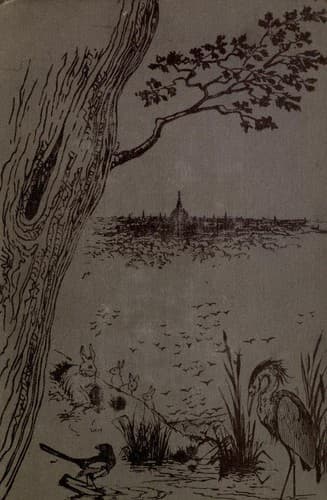
Country life -- England; Natural history -- Outdoor books; Nature study
The sudden shout startles me, and, glancing round, I find an empty black
barge, high out of the water, floating helplessly down upon me with the
stream. Noiselessly the great hulk had drifted upon me; as it came the
light glinted on the wavelets before the bow, quick points of brilliant
light. But two strokes with the sculls carried me out of the way.
NUTTY AUTUMN
There is some honeysuckle still flowering at the tops of the hedges,
where in the morning gossamer lies like a dewy net. The gossamer is a
sign both of approaching autumn and, exactly at the opposite season of
the year, of approaching spring. It stretches from pole to pole, and
bough to bough, in the copses in February, as the lark sings. It covers
the furze, and lies along the hedge-tops in September, as the lark,
after a short or partial silence, occasionally sings again.
But the honeysuckle does not flower so finely as the first time; there
is more red (the unopened petal) than white, and beneath, lower down the
stalk, are the red berries, the fruit of the former bloom. Yellow weed,
or ragwort, covers some fields almost as thickly as buttercups in
summer, but it lacks the rich colour of the buttercup. Some knotty
knapweeds stay in out-of-the-way places, where the scythe has not been;
some bunches of mayweed, too, are visible in the corners of the stubble.
Silverweed lays its golden flower--like a buttercup without a
stalk--level on the ground; it has no protection, and any passing foot
may press it into the dust. A few white or pink flowers appear on the
brambles, and in waste places a little St. John's wort remains open, but
the seed vessels are for the most part forming. St. John's wort is the
flower of the harvest; the yellow petals appear as the wheat ripens, and
there are some to be found till the sheaves are carted. Once now and
then a blue and slender bell-flower is lighted on; in Sussex the larger
varieties bloom till much later.
By still ponds, to which the moorhens have now returned, tall spikes of
purple loosestrife rise in bunches. In the furze there is still much
yellow, and wherever heath grows it spreads in shimmering gleams of
purple between the birches; for these three, furze, heath, and birch are
usually together. The fields, therefore, are not yet flowerless, nor yet
without colour here and there, and the leaves, which stay on the trees
till late in the autumn, are more interesting now than they have been
since they lost their first fresh green.
Public-domain text, read in full here on John Shaqi.
Reviews
Reviews
No reviews yet
Be the first to share your thoughts on this work.
Elsewhere in the archive
Join the Discussion
Join the discussion
Sign in to leave a comment or review.
Sign InorCreate an account