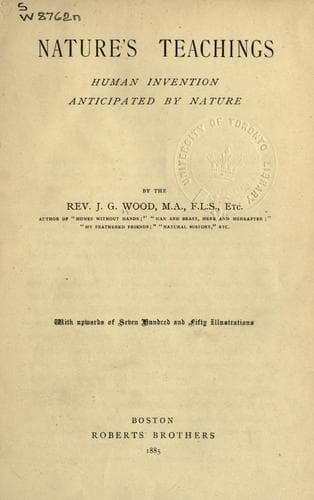
Nature's Teachings: Human Invention Anticipated by NatureWood, J. G. (John George)
History
Nature's Teachings: Human Invention Anticipated by Nature
Wood, J. G. (John George)
Inventions; Natural history
It is a really wonderful fact that the insect which, for three stages in
life--namely, an egg, larva, and pupa--lived in the water, should in the
fourth not only be incapable of aquatic life, but should employ its old
skin to protect it from that very element in which it was living only a
minute or two before.
Should the reader wish to examine for himself either the egg or skin
boat of the Gnat, he can easily procure them by searching any quiet
pond, or even an uncovered water-butt. They are, of course, very small,
averaging about the tenth of an inch in length, and are nearly always to
be found close to the side either of pond or tub, being drawn there by
the power of attraction.
I may here mention that there are other dipterous insects belonging to
the genus Stratiomys, which undergo their metamorphosis in a very
similar fashion. In these insects, the larva breathes through the tail,
and when it attains its pupal condition, the actual insect is very much
smaller than the pupal skin, only occupying the anterior and enlarged
part. Indeed, the difference of size is so great, that several
entomologists believed the future Stratiomys to be but a parasite on the
original larva. The beautiful Chameleon-fly (_Stratiomys chamæleon_) is
a familiar example of these insects.
NAUTICAL.
CHAPTER II.
THE OAR, THE PADDLE, AND THE SCREW.
Propulsion by the Oar.--Parallels in the Insect World.--The
“Water-boatman.”--Its Boat-like Shape.--The Oar-like Legs.--Exact
mechanical Analogy between the Legs of the Insect and the Oars of
the human Rower.--“Feathering” Oars in Nature and Art.--The
Water-boatman and the Water-beetles.--The Feet of the Swan, Goose,
and other aquatic Birds.--The Cydippe, or Beroë.--The
Self-feathering Paddle-wheel.--Indirect Force.--The Wedge, Screw,
and Inclined Plane.--“Sculling” a Boat.--The “Tanka” Girls of
China.--Mechanical Principle of the Screw, and its Adaptation to
Vessels.--Gradual Development of the Nautical Screw.--Mechanical
Principle of the Tail of the Fish, the Otter, and the sinuous Body
of the Eel and Lampern.--The Coracle and the Whirlwig-beetle.
Public-domain text, read in full here on John Shaqi.
Reviews
Reviews
No reviews yet
Be the first to share your thoughts on this work.
Join the Discussion
Join the discussion
Sign in to leave a comment or review.
Sign InorCreate an account