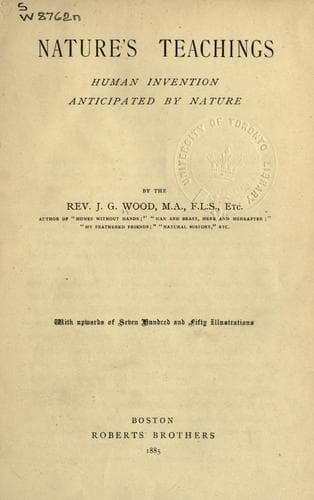
Nature's Teachings: Human Invention Anticipated by NatureWood, J. G. (John George)
History
Nature's Teachings: Human Invention Anticipated by Nature
Wood, J. G. (John George)
Inventions; Natural history
“That it should be thus slightly built is not surprising, for it is
intended as a temporary structure for protecting the insect while it is
excavating its hole, and as a pile of materials, well arranged and ready
at hand, for the completion of the interior building,--in the same way
that workmen make a regular pile of bricks near the spot where they are
going to build. This seems, in fact, to be the main design of the tower,
which is taken down as expeditiously as it has been reared.
“Réaumur thinks, that by piling in the sand which has previously been
dug out, the wasp intends to guard its progeny for a time from being
exposed to the too violent heat of the sun; and he has sometimes even
seen that there were not sufficient materials in the tower, in which
case the wasp had recourse to the rubbish she had thrown out after the
tower was completed. By raising a tower of the materials which she
excavates, the wasp produces the same shelter from external heat as a
human being would who chose to inhabit a deep cellar of a high house.
“She further protects her progeny from the ichneumon-fly, as the
engineer constructs an outwork to render more difficult the approach of
an enemy to the citadel. Réaumur has seen this indefatigable enemy of
the wasp peep into the mouth of the tower, and then retreat, apparently
frightened at the depth of the cell which she was anxious to invade.”
It is no wonder that the Sand-wasp should be so anxious to insure the
safety of her nest, for her foes are multitudinous. Putting aside the
ordinary Ichneumon-flies, we have the predatory Tachinæ, which are
always hovering over such nests, and trying to deposit eggs therein. For
many years I have been in the habit of receiving letters from novices in
entomology, wanting to know whether I am aware that the common Housefly
is in the habit of acting as a parasite. Of course, the writer has
mistaken the Tachina for a house-fly, but I cannot regret the fact that
some one has really begun to observe Nature, and not only to read books.
DOORS AND HINGES.
Having seen that both in Nature and Art the entrances to dwellings are
guarded by tunnel-like approaches, we come naturally to another mode of
guarding the entrance, namely, by a door moving on hinges. As to the
multitudinous examples of doors and hinges in modern civilisation, we
need hardly discuss them, except to show the exact analogies which occur
in Art and Nature.
Doors moving on hinges are very plentiful in Nature, even where we
should least expect them. Take, for example, an egg, especially the egg
of an insect, and we shall see that it is just about the last object in
which we should expect to find a hinged door. Yet, if the reader will
refer to the illustration on page 7, he will see that the tiny eggs of
the common Gnat, numerous as they may be, are each furnished with a door
which opens as soon as the inmate is hatched, and allows the little
larva to escape into the water.
Public-domain text, read in full here on John Shaqi.
Reviews
Reviews
No reviews yet
Be the first to share your thoughts on this work.
Elsewhere in the archive
Join the Discussion
Join the discussion
Sign in to leave a comment or review.
Sign InorCreate an account