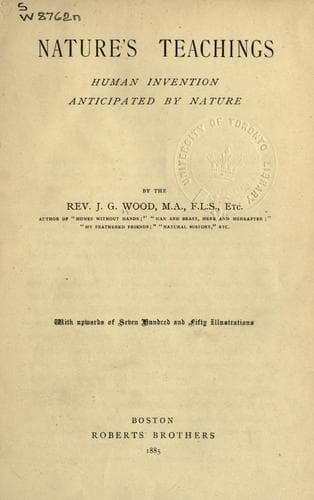
Nature's Teachings: Human Invention Anticipated by NatureWood, J. G. (John George)
History
Nature's Teachings: Human Invention Anticipated by Nature
Wood, J. G. (John George)
Inventions; Natural history
Another still more remarkable instance of a hinged door in an egg is to
be found in one of the Rotifers, or Wheel-Animalcules, so called because
they possess an apparatus of movable cilia, which, when set in motion,
looks exactly like a wheel running round and round. As the full-grown
creature is barely one thirty-sixth of an inch in total length, the
structure of its eggs must be infinitesimally beyond the range of human
vision.
Yet, just as the telescope sets at partial defiance the vast spaces that
intervene between our earth and her sister planets, so the microscope
performs a similar task in the infinitesimally minute. And, under the
all-revealing lens of the microscope, the little egg of the Brachionus,
though absolutely invisible to the unaided eye, yields up its secrets.
Fortunately, the shell is so transparent that the interior of the egg
can be seen through it as if it were a mere film of glass. The
astonishing division and re-division of the yolk take place before our
eyes, being divided first into two, then into four, then into eight,
then into sixteen, then into thirty-two, and so on, until the whole mass
of the yolk is cloven into divisions too numerous to count.
By degrees, the form of the young Brachionus is developed within the
egg, even to the very teeth, which work away as persistently as if large
stores of food were being passed through them.
When the young is ready to take its place in the world, a new
development occurs, which has been well related by Mr. Gosse:--
“All these phenomena have appeared in the egg we are now watching; and
at this moment you see the crystalline little prisoner, writhing and
turning impatiently within its prison, striving to burst forth into
liberty.
“Now, a crack, like a line of light, shoots round one end of the egg,
and in an instant, the anterior third of the egg is forced off, and the
wheels of the infant Brachionus are seen rotating as perfectly as if the
little creature had had a year’s practice.
“Away it glides, the very image of its mother, and swims to some
distance before it casts anchor, beginning an independent life. At the
moment of escape of the young, the pushed-off lid of the egg resumes its
place, and the egg appears nearly whole again, but empty and perfectly
hyaline (_i.e._ all but transparent), with no evidence of its fracture,
except a slight interruption of its outline, and a very faint line
running across it.”
To pass from the egg to a more advanced stage in life. All practical
entomologists have been greatly annoyed, in their earlier years of
collecting, to lose larva after larva, from the attacks of
Ichneumon-flies. It _is_ certainly rather beyond the limits of ordinary
patience to discover, watch over, and secure successfully a rare
caterpillar, and then to find that it has been “stung” by an
Ichneumon-fly.
Public-domain text, read in full here on John Shaqi.
Reviews
Reviews
No reviews yet
Be the first to share your thoughts on this work.
Elsewhere in the archive
Join the Discussion
Join the discussion
Sign in to leave a comment or review.
Sign InorCreate an account