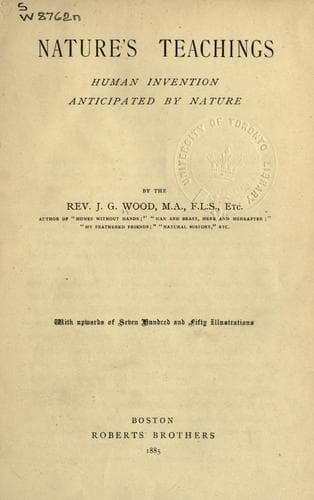
Nature's Teachings: Human Invention Anticipated by NatureWood, J. G. (John George)
History
Nature's Teachings: Human Invention Anticipated by Nature
Wood, J. G. (John George)
Inventions; Natural history
The veteran entomologist, however, troubles himself very little about
such minor misfortunes, and, as a rule, more than compensates for them
by preserving the intrusive Ichneumon-fly, and giving in his diary full
details of the insect on which it was parasitic, of the plant on which
the caterpillar lived, the date of its appearance, and its numbers.
Now, there are many of these parasitic insects, notably those belonging
to the genus Microgaster, which invariably make doors in their cocoons.
I have now before me groups of cocoons made of the two commonest British
species, namely, _Microgaster glomeratus_ and _Microgaster alvearius_,
and in both of them each tiny cocoon is furnished with a hemispherical,
hinged door. I have also some exquisitely beautiful groups of
Microgaster cocoons found in the West Indies. They are the purest white,
shine with a satiny lustre, and are arranged round a hollow centre, much
as if they had been gummed to the outside of a very large thimble. There
are many hundreds of them, and every one has its little door still open
as it was when the fully developed insect first made its escape.
* * * * *
ANOTHER curious example of a natural door may be seen by those who will
look for it.
On plants infested with aphides, or “green blight,” as the gardeners
quaintly term them, may often be seen dead aphides much larger than the
rest, globular, brown, and shining. These aphides have been “stung,” as
it is called, by a little Ichneumon-fly belonging to the genus Ophion,
and having, like all its congeners, a flat and sickle-shaped abdomen.
The egg which has been laid in the aphis soon hatches, and the young
Ophion absorbs into itself all the juices of the aphis. It remains
within the body of its involuntary host until it is fully developed,
when it cuts a tiny, but beautifully perfect circular door in the skin,
and emerges, leaving the door open and still attached by its little
hinge.
Considering the small size of the aphis, and that the diameter of the
door is only one-eighth of the length of the insect, the perfection of
its form is really remarkable.
* * * * *
ONE of the achievements of modern Architecture is the Self-closing Door,
especially where it must of necessity close by its own weight, and when
the fitting is so exact, that even the most experienced eye can
scarcely detect it. Such a door is to be found guarding the nest of the
Trap-door Spiders, several species of which are found scattered over all
the warm parts of the earth. A side view of one of these extraordinary
nests is given in the accompanying illustration, and on the other side
is the common trap-door of our cellars.
[Illustration: DOOR OF TRAP-DOOR SPIDER.]
[Illustration: TRAP-DOOR OF COAL-CELLAR.]
Public-domain text, read in full here on John Shaqi.
Reviews
Reviews
No reviews yet
Be the first to share your thoughts on this work.
Elsewhere in the archive
Join the Discussion
Join the discussion
Sign in to leave a comment or review.
Sign InorCreate an account