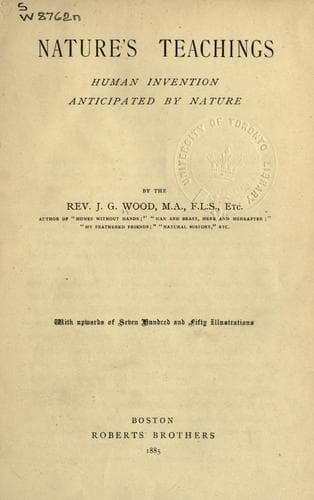
Nature's Teachings: Human Invention Anticipated by NatureWood, J. G. (John George)
History
Nature's Teachings: Human Invention Anticipated by Nature
Wood, J. G. (John George)
Inventions; Natural history
This fact is, perhaps, greatly owing to the influence of climate. In the
parts of the world which have been mentioned in connection with this
subject, light and heat appear to be rather enemies than friends, and
the object of the architect was to enable the inhabitants of his houses
to avoid rather than to welcome both. Consequently, the Windows were
comparatively insignificant. They were not needed for the purposes of
light or air, those being generally furnished by the aperture in the
roof, and consequently were kept out of sight as much as possible.
But when architects had to build for a sterner, a colder, and a darker
clime, where the sun never assumed that almost devouring heat and light
which in hot countries drive the inhabitants to invent endless devices
for obtaining coolness and shade, a different style of Architecture
sprang up. In this the Window became nearly the most prominent part of
the building: the elements were excluded by glass instead of stone, and
the principal modifications of light were obtained by staining the glass
in various rich colours. Perhaps the Window has attained its culminating
point in the Crystal Palace, which is all window except its foundations.
Partly in order to enable the glass to be inserted, and partly to
increase the beauty of the building, and to avoid the mean appearance of
Windows filled in with plain iron bars crossing each other at right
angles, the interior of the Windows was adorned with stone “tracery,”
varying much according to the epoch of the building.
[Illustration: CADDIS GRATING.]
[Illustration: WHEEL-WINDOW.]
One of the most beautiful forms of the Window is that which is called
the Wheel. The window itself is circular, and the tracery is disposed so
as to bear an exact resemblance to an ornamental wheel, the lines of the
tracery running from the circumference to the centre, just like the
spokes of a wheel. One of these Wheel-windows is shown on the right hand
of the illustration.
On the other side is an object, which at a hasty glance might be taken
for another Window of the same character. It is, however, the work of an
insect, and not of man, and is magnified in order to show its structure
better.
Any of my readers who may happen to be entomologists or anglers, or
both, are familiar with the Caddis-worm of our fresh waters. Most of us
know that the Caddis is the grub or larva of the Stone-fly
(_Phryganea_), an insect haunting the waterside, and so moth-like in its
general aspect that many persons think that it is really a brown moth.
The changes or metamorphoses of these insects are well worthy of notice.
Public-domain text, read in full here on John Shaqi.
Reviews
Reviews
No reviews yet
Be the first to share your thoughts on this work.
Elsewhere in the archive
Join the Discussion
Join the discussion
Sign in to leave a comment or review.
Sign InorCreate an account