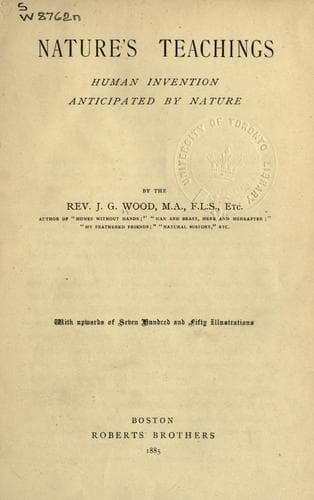
Nature's Teachings: Human Invention Anticipated by NatureWood, J. G. (John George)
History
Nature's Teachings: Human Invention Anticipated by Nature
Wood, J. G. (John George)
Inventions; Natural history
When the pupa is about to make its final change into the perfect form,
it cuts away the tracery with a pair of sharp jaws, with which it is
furnished for this sole purpose, emerges from the water, throws off the
pupa-skin, and issues forth as a Stone-fly.
GIRDERS, TIES, AND BUTTRESSES.
Next in order come the means by which walls are supported internally by
Girders and Ties, and externally by Buttresses.
* * * * *
OF late years the Girder, in its many varieties, has come into general
use, especially in the construction of railway bridges and similar
edifices.
[Illustration: RADIUS AND ULNA OF HUMAN ARM.]
[Illustration: GIRDER (FROM A HOUSE IN BERMONDSEY).]
On the right of the accompanying illustration is shown the Girder in its
simplest form. The figure was taken from a Girder which is used in
supporting the walls of a large building in Bermondsey. Sometimes a
transverse stay connects the centres of the two curved beams; but it is
seldom needed.
The reader will see that if the interval between the curved beams were
to be filled up, we should obtain a form very like that of the engine
beam described in page 25; while, if we could imagine two such girders
intersecting each other at right angles throughout their length, a
section of the two would exactly resemble the section of the engine beam
as given in the uppermost figure in page 25.
* * * * *
IN the human body there are four admirable examples of the natural
Girder, namely, in the bones of the arms and legs.
On the left hand of the illustration are shown the two bones of the
fore-arm, technically named the “radius” and “ulna.” It will be seen
that these bones are arranged on the principle of the girder. In men who
are especially powerful of grasp, it has been noticed that the curve of
the radius and ulna has been exceptionally bold, while we have it
developed to the greatest extent in the fore-arm of the Gorilla, an
animal whose arms are simply gigantic.
The two bones of the legs, from the knee to the ankle, are arranged in a
similar manner, and are called the “tibia” and “fibula.” The last named
signifies a brooch, and is given to the bone because it is very slender,
nearly straight, and when in its place bears no small resemblance to the
pin of the fibula, or ancient Roman brooch.
Nature, however, has exceeded Art in her girder. Those of man’s
manufacture can only exert their strength in one direction, and would be
of little use if force were to be applied to them in any other
direction. Those of the human body, however, have the capability of
partial revolution on each other at their points of junction, thus
enabling the Girder to apportion its strength according to the direction
of the resistance which it has to overcome.
* * * * *
Public-domain text, read in full here on John Shaqi.
Reviews
Reviews
No reviews yet
Be the first to share your thoughts on this work.
Elsewhere in the archive
Join the Discussion
Join the discussion
Sign in to leave a comment or review.
Sign InorCreate an account