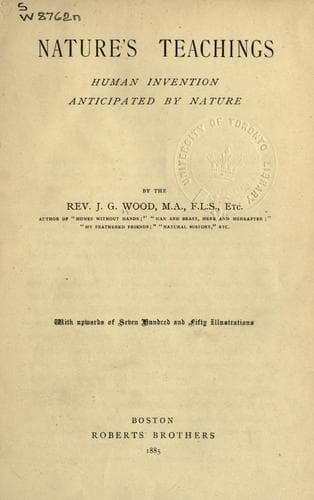
Nature's Teachings: Human Invention Anticipated by NatureWood, J. G. (John George)
History
Nature's Teachings: Human Invention Anticipated by Nature
Wood, J. G. (John George)
Inventions; Natural history
WE now come to the Ties, _i.e._ those internal beams, whether of metal,
wood, stone, or brick, which prevent walls from falling outwards. There
is no danger of the walls falling inward, but there is very great danger
of their falling outward, especially when the weight or “thrust” of the
roof tends to force them apart.
In some buildings, such as an old country church which I attended for
many years, the architect had openly acknowledged the tendency of the
walls to fall outward, and had counteracted it by a series of great
beams extending completely across the nave and aisle. As he had not even
troubled himself to hide their office, so he did not trouble himself to
conceal the fact that they were tree-trunks, but left them roughly
squared with the axe, lest, if he had squared them throughout their
length, he should have diminished their strength.
The effect of the partially squared beam is, of course, far more
picturesque than that of a completely squared one. The architect,
however, need not have been so careful about strength, for if the beams
had been only half their diameter they would have been just as
effective. The strain on them is by pulling, and not by pushing. Now, as
any one can see by trying the experiment with a splinter of wood--say a
lucifer-match--an enormous power is required to break it by tearing the
ends asunder, while it can be easily broken by pushing them towards each
other.
But for this power of resistance, we should never have had our Crystal
Palace. That apparently intricate, but really simple (and the more
beautiful for its simplicity), intersection of beams and lines
diminishing in the distance to the thickness of spiders’ webs, is
nothing more than a combination of the Girder and Tie, the two together
combining lightness and strength in a marvellous manner.
The story of the Crystal Palace is now so well known that it need not be
repeated in detail. A vast building was required for the Exhibition of
1851, and not an architect was able to supply a plan which did not
exhibit some defect which would make the building almost useless.
Suddenly a Mr. Paxton, who was a gardener, and not an architect,
produced (on a sheet of blotting-paper) a rough plan of a building on a
totally new principle, and not only fulfilling all the requisite
conditions, but being capable of extension in any direction and to any
amount. There have been very few bolder conceptions than that of making
iron and glass take the place of brick, stone, and timber, and the
result fully justified the expectations even of the inventor.
Public-domain text, read in full here on John Shaqi.
Reviews
Reviews
No reviews yet
Be the first to share your thoughts on this work.
Elsewhere in the archive
Join the Discussion
Join the discussion
Sign in to leave a comment or review.
Sign InorCreate an account