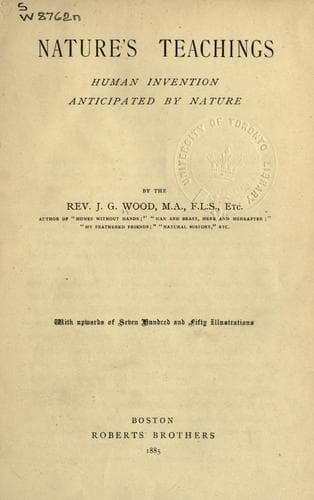
Nature's Teachings: Human Invention Anticipated by NatureWood, J. G. (John George)
History
Nature's Teachings: Human Invention Anticipated by Nature
Wood, J. G. (John George)
Inventions; Natural history
How a gardener suddenly developed into an architect remains to be seen;
and, indeed, in this case the architecture was the result of the
gardening, or rather, of practical botany applied to art. Some years
before the invention of the Crystal Palace, that magnificent plant, the
Victoria Regia, had been introduced into England. Its enormous leaves,
with their wonderful power of flotation, caused a great stir at the
time, and some of my readers may remember a sketch which was engraved in
the _Illustrated London News_, and which represented a little girl
standing on one of these leaves as it floated on the water.
[Illustration: LEAF OF VICTORIA REGIA (REVERSED).]
[Illustration: CRYSTAL PALACE.]
Mr. Paxton saw how this power was obtained, and the result was that he
copied in iron the lines of the vegetable cellular structure which gave
such strength to the Victoria Regia leaf, and became more eminent as an
architect than he had been as a gardener. The capabilities of the
Crystal Palace had lain latent for centuries, but the generalising eye
of genius was needed to detect it. A thousand men might have seen the
Victoria Regia leaf, and not thought very much of it; but the right man
came at the right time, the most wonderful building in the world sprang
up like the creation of a fairy dream, and the obscure gardener became
Sir Joseph Paxton.
I have no doubt that thousands of similar revelations are at present
hidden in Nature, awaiting the eye of their revealer.
* * * * *
NOW we come to the principle of the Buttress, _i.e._ giving support to
the exterior, instead of the interior, and strengthening the walls by
pushing them together, instead of pulling them together.
Putting aside the “flying” buttress, which is simply one buttress
mounted on another to support the clerestory walls, the structure of the
ordinary buttress is simple enough.
The most primitive form of the buttress is often found in country farms,
where the farmer sees the walls of his barns and outhouses leaning
suspiciously on one side, and, instead of going to the root of things,
props them up by a stout pole or beam.
This, however, can be nothing but a temporary arrangement, especially as
beams have a tendency to rot, and their ends to sink into the earth by
the gradual pressure of the wall. The genuine buttress was therefore
evolved, the basal part being very thick and heavy, and the upper part
comparatively thin and slight. Simple as a buttress looks, much skill is
needed in making it, and if it be not rightly built, it does infinitely
more harm than good.
Public-domain text, read in full here on John Shaqi.
Reviews
Reviews
No reviews yet
Be the first to share your thoughts on this work.
Elsewhere in the archive
Join the Discussion
Join the discussion
Sign in to leave a comment or review.
Sign InorCreate an account