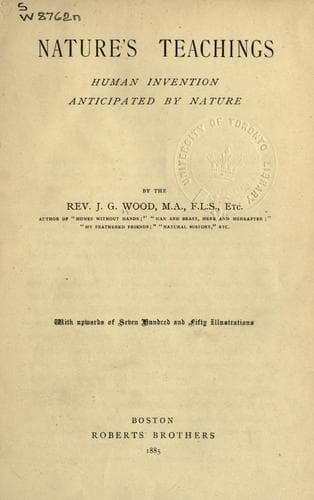
Nature's Teachings: Human Invention Anticipated by NatureWood, J. G. (John George)
History
Nature's Teachings: Human Invention Anticipated by Nature
Wood, J. G. (John George)
Inventions; Natural history
Generally speaking, the Terebella works only in the evening, but, if it
be hastily deprived of its tube, it cannot help itself, and is perforce
obliged to work while it can. It is worthy of remark that the Terebella,
although, as a rule, it lives in a tube all its life, is capable of
swimming with the usual serpentine motion of marine worms, and, when
taken out of its tube, rushes about violently, and soon exhausts itself
by its efforts.
Along most of our rocky seashores may be seen vast quantities of a sort
of hardened sand, penetrated with small tubes. On a closer examination
this sand-mass is resolved into a congeries of tubes, matted and twisted
together, and each being the habitation of a marine worm called the
Sabella. This name is derived from a Latin word signifying sand, and is
given to the worm in allusion to the material of which it makes its
habitation.
Like the Terebella, the Sabella uses its tentacles for the purpose of
building the tubes, which are much stiffer than those of the Terebella.
They are strong enough, indeed, to give the feet a firm hold while
traversing the rocks, and this, is a matter of no small moment when the
tide is coming in, and the shore has to be regained without loss of
time.
Then we have other marine worms, known as Triquetra and Serpula, which
make tubes in a somewhat similar manner, but of very fine materials and
very strong cement, so that the tube is nearly as hard as stone.
Space would fail me if I were to enumerate these creatures at greater
length, but enough has been said to show that man’s invention of
subaquatic cement has been anticipated in Nature by the inhabitants both
of salt and fresh water.
* * * * *
WE now come to the subject of Paint and Varnish. Putting aside their use
as a means to increase the beauty of the object to which they are
applied, we will view them in the light of preservatives, and
acknowledge the truth of the old Dutch proverb, that “Paint costs
nothing.” Certainly, when the wood to which it is applied is thoroughly
dry from within, it not only costs nothing, but repays itself over and
over again as a preservative of the wood, and a defence against moisture
from without.
The instances in which Paint is applied to wood are too numerous to be
mentioned. Perhaps some of my readers may remember the case of the naval
captain who, on taking command of his ship, was supplied, according to
custom, with exactly half the amount of paint required for her. The
invariable etiquette had been that the captain supplied the remaining
half at his own cost. But the officer in question was not at all
disposed to be “put upon,” and was a thorn in the sides of the “Naval
Lords.”
Public-domain text, read in full here on John Shaqi.
Reviews
Reviews
No reviews yet
Be the first to share your thoughts on this work.
Elsewhere in the archive
Join the Discussion
Join the discussion
Sign in to leave a comment or review.
Sign InorCreate an account