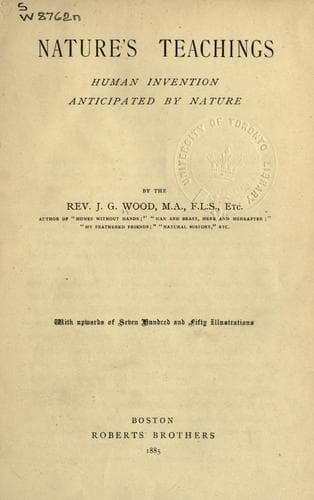
Nature's Teachings: Human Invention Anticipated by NatureWood, J. G. (John George)
History
Nature's Teachings: Human Invention Anticipated by Nature
Wood, J. G. (John George)
Inventions; Natural history
Finding, by actual measurement, that the paint supplied to him was only
half the amount which was really needed for the ship, he sent his
respectful compliments to the Admiralty, asking whether they wished the
port or the starboard side of the ship to be painted, for that there was
only enough paint for one half of the ship, and he awaited instructions
as to which side of the vessel it was to be applied. He was impervious
to “minutes,” “directions,” &c., and, as far as I remember, this very
impracticable man got his way, and was supplied with the requisite
amount of paint.
* * * * *
LONG before man ever invented paint or varnish the Hive Bee had made use
of it.
Every one who has kept bees knows how they always fasten the edge of the
hive to the board, and stop up any crevices that may be left open. The
material which they use for this purpose is not wax, but a substance
called “propolis.” This term is composed of two Greek words, signifying
a suburb, or the outskirts of a town, and is given to this stationary
substance in consequence of the use which is made of it.
[Illustration: BEE VARNISHING CELLS.]
[Illustration: PAINTER VARNISHING WOOD.]
Not only do the bees use it for fastening the hives, but also for
strengthening their combs. Wax is a very precious material, and the
beautiful hexagonal structure of the bee-comb is intended for the
purpose of combining the greatest amount of storing space with the least
expenditure of material. The plates of wax of which the cells are
composed are so thin that their edges would break down even under the
feet of the bees as they passed over it, and accordingly the bees
strengthen the edges of the cells with propolis, as any one may see by
examining a piece of bee-comb. The propolis is of a darker colour than
the wax, and has a peculiar varnish-like appearance.
The propolis, as distinguished from wax, is mentioned by Virgil in his
Georgics:--
“Collectumque hæc ipsa ad munera gluten
Et visco et Phrygiæ servant pice lentius Idæ.”--_Georg._ iv. 40.
It is evident that the propolis cannot be obtained from the same source
as the wax. The latter is secreted by the bees under little plates or
flaps upon the abdomen, while the propolis is purely a vegetable
exudation. It is obtained from many trees, the principal being the horse
chestnut. All who have handled the buds of this tree are aware that they
are covered with a viscous and very adhesive matter, which serves as a
varnish or protection to the bud before the leaves are strong enough to
break out. This is the material which the bees gather for their
propolis, and at certain times of the year the chestnuts may be seen
swarming with bees, all busily engaged in scraping off the varnish.
TOOLS.
CHAPTER I.
THE DIGGING-STICK.--SPADE.--SHEARS AND SCISSORS.--CHISEL AND ADZE.--THE
PLANE AND SPOKESHAVE.
Public-domain text, read in full here on John Shaqi.
Reviews
Reviews
No reviews yet
Be the first to share your thoughts on this work.
Elsewhere in the archive
Join the Discussion
Join the discussion
Sign in to leave a comment or review.
Sign InorCreate an account