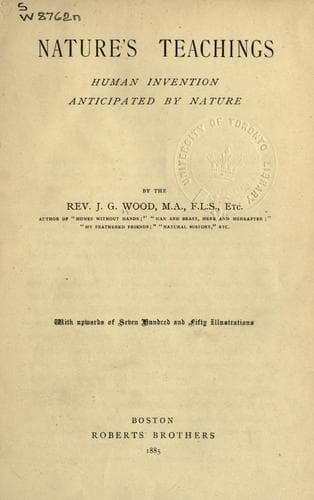
Nature's Teachings: Human Invention Anticipated by NatureWood, J. G. (John George)
History
Nature's Teachings: Human Invention Anticipated by Nature
Wood, J. G. (John George)
Inventions; Natural history
In order to render this very unpleasant task less disagreeable, some
ingenious individual invented the Guard Razor. The principal part of the
invention consisted in a plate of metal sufficiently thin not to add
materially to the weight of the razor, and sufficiently strong to resist
a moderate amount of pressure. This was fixed along the blade of the
razor in such a way that it just allowed the edge to show itself, and,
in fact, converted the razor into a plane or spokeshave. The exact
amount of edge which might be shown was regulated by screws, and the
guard itself could be removed at pleasure, so as to allow of the razor
being sharpened.
Now let us see if we can find any examples of the Plane or Spokeshave in
Nature.
* * * * *
I TRACE at least one example of the Plane in the insect world. More than
a hundred years ago, that very observant naturalist, Gilbert White,
noticed a bee performing a curious task. She was running up the stem of
the garden campion, holding her jaws extended, and stripping off the
down with all the dexterity of a hoop-shaver. She collected a bundle
nearly as large as herself, and then flew away with it. What she did
with her burden he knew not, but the history of the insect has been told
fully, though briefly, by Mr. F. Smith, in his “Catalogue of British
Hymenoptera:”--
“Although the species belonging to this genus are numerous, and are
found both in the Old and New World, there is only one found in this
country, _Anthidium manicatum_; this is truly a summer bee, not making
its appearance before the latter part of June or beginning of July.
“This insect, so far as my own observation has enabled me to ascertain,
does not construct its own burrow, but makes use of any hole which is
adapted to its purpose. I once detected a bee entering the hole above
the wheel of the sash-line in a summer-house; but its nests are most
commonly formed in the holes bored in old willow stumps by _Cossus
ligniperda_ (the Goat-moth): formerly they were easily obtained in
Battersea Fields, where the willows abounded.
“It is probable that when the parent insect has selected one of these
ready-formed tunnels, she enlarges the end used as the depository of the
nest, and this is easily effected, as the stumps in question, at the
depth of a couple of inches, consist of soft decayed wood.
“The chamber being formed, the bee collects a quantity of down from
woolly-stemmed plants, with which she forms an outer coating. She then
constructs a number of cells for the reception of the pollen, or food of
the larva; they consist of a woolly material, mixed with some glutinous
matter which resists the moisture of the food they contain, and in
which the larva, being full fed, spins a brown silken cocoon. These bees
pass the winter in a larva state, and do not appear until midsummer.
“In one respect, the sexes of this genus differ from most other bees,
the males being much larger than the females.”
Public-domain text, read in full here on John Shaqi.
Reviews
Reviews
No reviews yet
Be the first to share your thoughts on this work.
Elsewhere in the archive
Join the Discussion
Join the discussion
Sign in to leave a comment or review.
Sign InorCreate an account