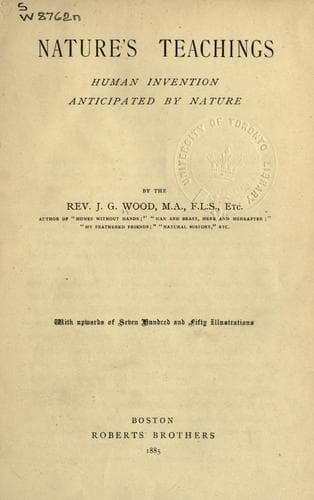
Nature's Teachings: Human Invention Anticipated by NatureWood, J. G. (John George)
History
Nature's Teachings: Human Invention Anticipated by Nature
Wood, J. G. (John George)
Inventions; Natural history
The reader will see from this account how exact is the analogy between
the carpenter’s plane and the jaws of the bee. In consequence of the
simile employed by Mr. White, the insect has been popularly known by the
title of the Hoop-shaver Bee. It is a tolerably common insect, and
abounds in the South of England.
TOOLS.
CHAPTER II.
THE SAW AND ITS VARIETIES.
Cutting Tools and their working.--Structure of the Edge.--The
Kris.--Edge of a Razor.--The Sword and the Apple.--Australian
Saw.--Fretwork Saw.--Various Saw-flies.--The Pioneer’s
Saw.--Cutting Tools of Trichiosoma.--Side Teeth of the Saws.--The
Cordon Saw, or Band Saw.--Tooth-ribbon of Whelks, Slugs, and other
Molluscs.--The Dog-whelk, or Purpura.--The Circular
Saw.--Sawyer-beetles and their Mode of Work.
Still keeping to the Cutting Tools and their varieties, we come to the
Saw, _i.e._ the cutting tool set with teeth upon its edge. Now, in plain
fact, there is no cutting instrument that does not more or less partake
of the character of the Saw; for, in the first place, it is absolutely
impossible for man to grind an edge so fine that, when magnified, it
will not appear to be deeply notched, and, in the next place, its
cutting powers are greatly due to the notches and teeth, and the
direction of their points.
We will take both these subjects in turn.
First, as to the notches, or serrated edge. I have now before me two
instruments, each the best of their kind, and in both of which the
serrations are essential to efficacy. The first is a Malayan dagger, or
“kris,” and the second is a surgeon’s lancet, made by Ferguson, of
London.
In the kris the edge is intentionally serrated, having been eaten away
by means of acids until the required effect was produced. The Malayans
know by experience that such an edge is most deadly in a weapon, and
that it will cut certain vital parts which a smoother edge might pass
without doing any damage.
Now we will take the lancet, and put it under the microscope, when it
assumes the most curious resemblance to the kris. Its mirror-like
surface looks as if it had been very roughly treated with a coarse file,
while its thin and delicate edge, which is perfectly smooth to the eye,
and which will pass through a piece of stretched wash-leather without
any apparent opposition, becomes as rough and jagged as that of the
Malayan weapon.
Take even, for example, the common butcher’s knife, which is perpetually
being sharpened on the “steel” that hangs at his belt. The reader may
observe that the butcher does not rub the blade of his knife backwards
and forwards on the steel, as unskilful persons do. Rapid as is the
movement gained by constant practice, any one may see that the blade is
always moved in one direction, so as to force the microscopical teeth to
point one way, and so to act as a saw when the knife is drawn across the
meat.
Public-domain text, read in full here on John Shaqi.
Reviews
Reviews
No reviews yet
Be the first to share your thoughts on this work.
Elsewhere in the archive
Join the Discussion
Join the discussion
Sign in to leave a comment or review.
Sign InorCreate an account