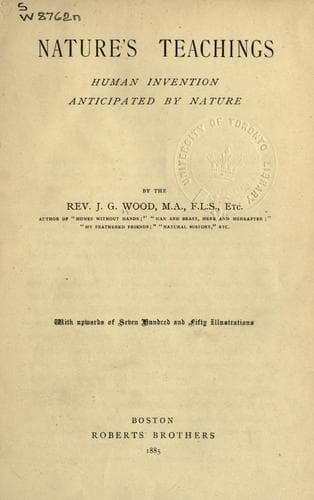
Nature's Teachings: Human Invention Anticipated by NatureWood, J. G. (John George)
History
Nature's Teachings: Human Invention Anticipated by Nature
Wood, J. G. (John George)
Inventions; Natural history
The power of these teeth or notches may be inferred from a well-known
fact. If a razor, no matter how sharp, be pressed upon the human skin
without any “draw,” it will indent the skin, but not cut it, while the
slightest drawing movement will cause a deep wound. It is the knowledge
of this fact that enables an expert swordsman to sever an apple placed
on the palm of the bare hand, without even scratching the skin. I have
witnessed this feat, and at once saw that it was due to the absence of
any “draw” to the cut. The apple was laid on the palm of the hand, which
was opened as widely as possible, so as to flatten it. The sword was
then brought down on the apple with a sort of chopping movement, so
that, although it indented the skin, it did not even inflict a scratch.
By the use of the “drawing” movement, the same sword severed a gauze
veil laid across it, the two halves floating in opposite directions. By
the same cut, I have seen some astonishing feats performed with an
Indian sword now in my collection, the objects of attack falling asunder
as if by magic, without any apparent force being used.
* * * * *
HAVING now glanced at the principle of the Saw, we will proceed to some
of its details.
The simplest form of Saw in existence is that which is in use among the
Australian natives, and consists of obsidian flakes set along one side
of a stick. It looks a rude and inefficient affair enough, but it can
cut better than might have been thought, as I can testify from
experiments on such a saw in my collection.
[Illustration: SAW OF COMMON SAW-FLY (MAGNIFIED). GROOVES CUT BY SAW IN
BARK.]
[Illustration: HAND-SAW. TENON SAW. PIONEER’S SAW-SWORD.]
Many as are the varieties of the Saw, the principle is the same in all,
and the chief distinction lies in the shape and arrangement of the
teeth, according to the work which they have to do. Watch-spring Saws,
for example, which have to cut metal, have their teeth so slight as to
be hardly perceptible, and arranged nearly in a line with each other.
The Fretwork Saws, which have to cut delicate patterns in wood, with the
slightest possible waste of material, are of the same character. Then we
have the long curved teeth of the Circular Saws, which tear their way
savagely through great tree-trunks, and fill the air with clouds of
sawdust. There are also the Tenon Saw, with its thin blade and broad
back; the pioneer’s saw for cutting green wood, with its double array of
teeth, so as to make a wide “kerf” in which it shall not be clogged;
together with many others that we cannot enumerate here.
* * * * *
WE will now examine some Saws as found in Nature.
Public-domain text, read in full here on John Shaqi.
Reviews
Reviews
No reviews yet
Be the first to share your thoughts on this work.
Elsewhere in the archive
Join the Discussion
Join the discussion
Sign in to leave a comment or review.
Sign InorCreate an account