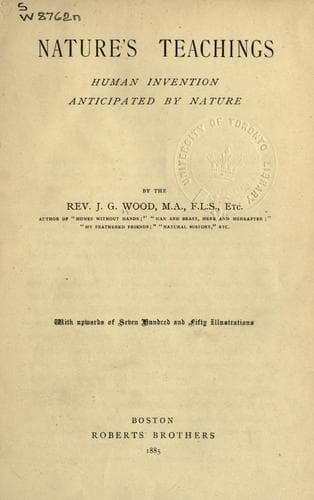
Nature's Teachings: Human Invention Anticipated by NatureWood, J. G. (John George)
History
Nature's Teachings: Human Invention Anticipated by Nature
Wood, J. G. (John George)
Inventions; Natural history
I need not state that with all bivalves the power is increased in
proportion to the size of the shell. Even an Oyster can pinch most
severely, while the Giant Clam, the shell of which weighs some four
hundred pounds, could nearly take off a man’s leg if it seized him.
Mr. J. Keast Lord, in his “Naturalist in British Columbia,” relates an
amusing story that was told to him by an old settler respecting the
power of the Clam’s grip:--
“You see, sir, as I was a-cruising down these flats about sun-up, the
tide jist at the nip, as it is now, I see a whole pile of
shoveller-ducks snabbling in the mud, and busy as dogfish in herring
time. So I creeps down, and slap I let ’em have it. Six on ’em turned
over, and off went the pack, gallows scared, and quacking like mad.”
“Down I runs to pick up the dead uns, when I see an old mallard
a-playing up all kinds o’ antics, jumping, backing, flapping, but fast
by the head, as if he had his nose in a steel trap; and when I comes up
to him, blest if a large Clam hadn’t hold of him, hard and fast, by the
beak.”
“The old mallard might ha’ tried his hardest, but may I never bait a
martin-trap again if that Clam wouldn’t ha’ held him agin any odds till
a tide run in, and then he’d ha’ been a gone shoveller sure as shooting.
So I cracked up the Clam with the butt of my old gun, and bagged the
mallard.”
Of course the reader will remember that this was only an ordinary Clam,
and not one of the giant race.
* * * * *
BELOW the shell are two very perfect instances of natural Pincers, each
acting in a different manner, but on the same principle.
The Earwig is too familiar to need much description, but I may as well
state that its pincers are not primarily intended as weapons, although
they can be so used on occasion. (I was about to say, at a pinch, but
refrain.) They resemble our ordinary pincers in that both blades move
equally, and they are so completely under the control of their owner,
that the insect uses them with a delicacy of touch that a lady’s fingers
could hardly surpass. They are really tools, and not weapons, and are
employed for the purpose of folding the wide and delicate wings under
the tiny elytra.
There is another insect called the Scorpion-fly (_Panorpa_), the male of
which is furnished with a pair of pincers at the end of a long and
flexible tail, articulated just like the tail of a scorpion, and moved
in exactly the same manner. It is but a little insect, but its gestures
are so menacing as it flourishes its tail about, that non-entomologists
may well be pardoned for being afraid of it. Moreover, small as are the
pincers, they really can give a smart nip, and make themselves felt on
the human skin.
* * * * *
Public-domain text, read in full here on John Shaqi.
Reviews
Reviews
No reviews yet
Be the first to share your thoughts on this work.
Elsewhere in the archive
Join the Discussion
Join the discussion
Sign in to leave a comment or review.
Sign InorCreate an account