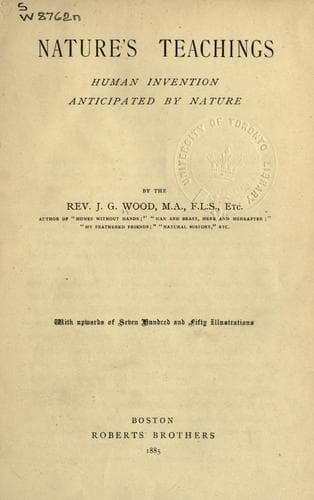
Nature's Teachings: Human Invention Anticipated by NatureWood, J. G. (John George)
History
Nature's Teachings: Human Invention Anticipated by Nature
Wood, J. G. (John George)
Inventions; Natural history
IF we want examples of exceedingly powerful pincers, we need only go to
the Lobsters and Crabs, especially to the latter, whose claws are often
of enormous thickness in proportion to the size of the animal. All those
who have visited the seaside know how severe is the pinch of the common
Green Crab, comparatively small though it be, and the same may be said
of the river crayfish, which is, in fact, a lobster in miniature.
As to the lobster itself, fishermen are so well acquainted with the
power of its claws, that they tie them together with string as soon as
the animal is caught. Formerly they used to “peg” them, _i.e._ drive a
wooden peg into the joint so as to prevent it from moving. This custom,
however, is now prohibited by law on account of its cruelty.
The power of the Crab’s claws is so great that a bite from a large Crab
will inflict a severe injury, and render a hand helpless. It has more
than once happened that men who have been feeling for Crabs in the
recesses of the rocks at low water have been seized, and seriously
imperilled, not being able to release themselves from the gripe.
Indeed, it is said that there have been instances where the Crab has
held so tightly, that the man has been drowned by the returning tide, no
one having come to his assistance. I am, however, inclined to doubt this
statement, thinking that the Crab would not be likely to remain in its
hiding-place very long after the water came up. Still, that such an idea
should be currently believed in many parts of England shows the
estimation in which the gripe of the Crab’s claw is held.
TOOLS
CHAPTER IV.
POLISHING TOOLS.--MEASURING TOOLS.
Files and Sand-papers.--The Sheffield File and its Structure.--The
Equisetum, Mare’s Tail, or Dutch Rush.--Beauty of its Surface when
seen through the Microscope.--Sand-paper.--Skin of Dog-fish, Skate,
and Shark.--Skate-skin used for Sword-handles.--Distinction between
the File and Sand-paper.--Measuring Tools.--The Plumb-rule and the
Level.--Their Use in Tunnelling.--The Measure and its Uses.--The
Two-foot Rule and the Tape Measure.--Ovipositor of
Gall-fly.--Tongues of the Woodpecker, Wryneck, and Creeper.--The
Spirit-level and its Uses.--Theodolite and Callipers in Nature and
Art.--The Contouring-glass.--Pincers of Earwig again.--Jaws of
Insects.--The great Sialis of Columbia.
FILES AND SAND-PAPERS.
Having now examined the analogies between the cutting, boring, striking
and grasping tools of Nature and Art, we come to those finishing tools
which smooth and polish the surface.
Public-domain text, read in full here on John Shaqi.
Reviews
Reviews
No reviews yet
Be the first to share your thoughts on this work.
Elsewhere in the archive
Join the Discussion
Join the discussion
Sign in to leave a comment or review.
Sign InorCreate an account