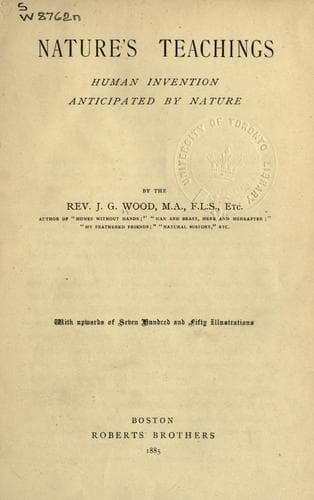
Nature's Teachings: Human Invention Anticipated by NatureWood, J. G. (John George)
History
Nature's Teachings: Human Invention Anticipated by Nature
Wood, J. G. (John George)
Inventions; Natural history
There is a well-known museum in which these swords are labelled as
having handles of “granulated ivory.” Now, in the first place, there is
no such thing as granulated ivory; and, in the next, a mere glance ought
to tell the observer that the so-called ivory is a skin of some sort,
worked upon the handle while wet, and kept in its place by copper studs.
Even the junction of the edges is perceptible, and yet the authorities
of the museum in question, although they have been repeatedly corrected,
still persist in calling the skate-skin by the absurd title of
granulated ivory.
However, if ivory could be granulated, it would certainly look very much
like the skate-skin. When examined closely, the scales, whether of
Dog-fish, Skate, Shark, or Saw-fish, are seen to resemble hexagonal
cones, not coming quite to a point, but truncated, so as to have an
hexagonal flattened tip. They are almost of a flinty hardness,
especially at their tips, and on inspection of them the observer is not
surprised at the use of Dog-fish skin in place of sand-paper.
Perhaps the reader may ask why the Equisetum should be taken as the
prototype of the file, and the skin of the Dog-fish as that of
sand-paper. The reason is this. The flinty points of the Equisetum are
set upon parallel ridges something like those of a file, while the
scales of the Dog-fish are without any apparent order, being crowded
against each other like the cutting particles upon the sand-paper. That
there should not be an order, and that a definite one, is out of the
question. But it has not yet been detected by human eyes, and therefore
may be practically treated as non-existent.
TOOLS OF MEASUREMENT.
In many of the arts, more especially those which belong to engineering
and carpentering as a part of architecture, it is absolutely necessary
to make sure of a perpendicular line, _i.e._ a line which, if continued,
would reach from any point of the earth’s surface to its exact centre
below and its zenith above. Were it not for the power of producing this
line, none of the great engineering works of modern or ancient days
could have been undertaken.
Take, for example, the wonderful tunnels which have been driven through
the earth, of which the Mont Cenis Tunnel is one of the greatest
triumphs of modern engineering. Beginning, as the workmen did, at
opposite ends of a tunnel many miles in length, and labouring only by
the lines laid down by the engineers, the men worked steadily on until
they met in the centre.
A few blows, and the then narrow dividing wall was shattered, the men
shook hands through the aperture, and then, after enlarging it, leaped
wildly from one side to the other, having successfully solved the great
problem. With such marvellous precision had the lines been laid, that
only a few inches had to be smoothed down on either side, and the sides
or walls of the tunnel showed no traces of the junction.
Public-domain text, read in full here on John Shaqi.
Reviews
Reviews
No reviews yet
Be the first to share your thoughts on this work.
Elsewhere in the archive
Join the Discussion
Join the discussion
Sign in to leave a comment or review.
Sign InorCreate an account