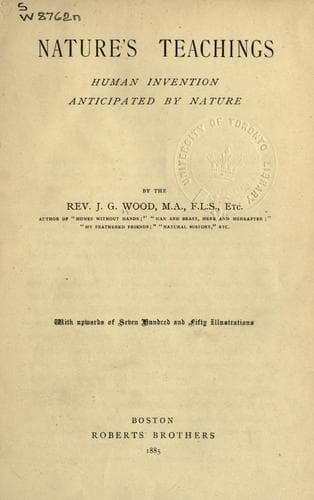
Nature's Teachings: Human Invention Anticipated by NatureWood, J. G. (John George)
History
Nature's Teachings: Human Invention Anticipated by Nature
Wood, J. G. (John George)
Inventions; Natural history
So rapid has been the progress of engineering that a tunnel of a mile in
length would, within the memory of man, have been thought as daring a
project as was the Mont Cenis Tunnel, which has just been given as an
example. Indeed, I know of a railway tunnel, not quite a mile in length,
where the engineers had committed some error, so that the two halves,
instead of meeting exactly, overlapped each other so much that the
mistake was only discovered by the workmen, who heard the strokes of
their companions’ picks on their sides, and not in front. Consequently,
a great waste of time took place, and the centre of the tunnel had to be
made with a double curve, like the letter S, and trains are obliged to
slacken speed until they have passed it.
Those who have lived long enough to remember the current literature of
the past generation will call to mind the ridicule that was cast upon
the idea of a tunnel that should pass under the Thames. That it would be
useful if it could be completed, no one ventured to doubt, but that such
an idea could be conceived by any one out of a lunatic asylum was rather
too much for the journalists of the day. However, the tunnel was made,
and so proved the theorists wrong on the one side. And, when made, it
was of very little use, which proved them wrong on the other side. Now
the proposal to carry a submarine tunnel from England to France excites
not half the opposition that was elicited by the comparative
child’s-play of a tunnel under the Thames.
The only mode of laying down the lines on which the men worked is by
suspending very heavy balls to very fine wires, and then, by means of
delicate optical instruments, ascertaining whether the wires are in line
with each other.
Familiar instances of the use of this principle may be seen in the
plumb-rule and level of the builder or carpenter. The latter, with a
base of ten feet in length, is often used by the gardener when he wishes
to lay the absolutely level lawns that are required for our modern game
of croquet, where the hoops are scarcely wider than the balls, and the
lawn has in consequence to be nearly as level as a billiard table.
I may here remark that the name plumb-rule is derived from the Latin
word _plumbum_, or lead, in allusion to the leaden weight at the end of
the string. The word “plumber” is due to the same source, and signifies
a worker in lead.
* * * * *
Public-domain text, read in full here on John Shaqi.
Reviews
Reviews
No reviews yet
Be the first to share your thoughts on this work.
Elsewhere in the archive
Join the Discussion
Join the discussion
Sign in to leave a comment or review.
Sign InorCreate an account