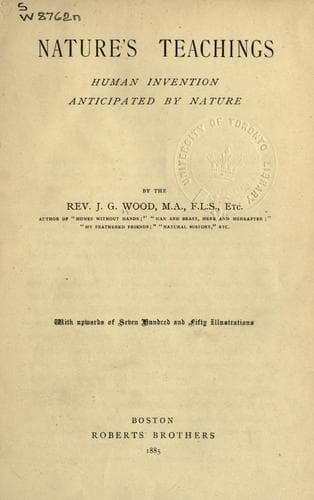
Nature's Teachings: Human Invention Anticipated by Nature — John Shaqi
Nature's Teachings: Human Invention Anticipated by NatureWood, J. G. (John George)
History
Nature's Teachings: Human Invention Anticipated by Nature
Wood, J. G. (John George)
Inventions; Natural history
IT is worth while, by the way, to remark how curiously similar are such
parallels. I have already mentioned the very evident resemblance between
the water-boatman, the water-beetles, and the human rower, the body of
the insect being shaped very much like the form of the modern boat. I
must now draw the attention of the reader to the similitude between the
very primitive boat known by the name of Coracle, and the common
Whirlwig-beetle (_Gyrinus natator_), which may be found in nearly every
puddle. The shape of the insect is almost identical with that of the
boat, and the paddle of the coracle is an almost exact imitation of the
swimming legs of the whirlwig. And, as if to make the resemblance
closer, many coraclers, instead of using a single paddle with two broad
ends, employ two short paddles, shaped very much like battledores.
[Illustration: WHIRLWIG BEETLE AND PADDLES.]
[Illustration: CORACLE AND PADDLE.]
NAUTICAL.
CHAPTER III.
SUBSIDIARY APPLIANCES.--PART I.
General Sketch of the Subject.--The Mast of Wood and Iron.--Analogy
between the Iron Mast and the Porcupine Quill.--The Iron Yard and
its Shape prefigured by the same Quill.--Beams of the
Steam-engine.--Principle of the Hollow Tube in place of the Solid
Bar.--Quills and Bones of Birds.--Wheat Straws and
Bamboos.--Structure of the Boat.--The Coracle, the Esquimaux Boat,
and the Bark Canoe.--Framework of the Ship and Skeleton of the
Fish.--Compartments of Iron Ship and Skull of Elephant.--The Rush,
the Cane, and the Sugar-cane.--“Stellate” Tissue and its Varieties.
Having now treated of the raft, the boat, the ship, and their various
modes of propulsion and guidance, we come to the subsidiary appliances
to navigation, if they may be so called in lack of a better name.
First in importance is necessarily the mast; and the yards, which
support the sails, are naturally the next in order. Then there come the
various improvements in the building of vessels; namely, the
substitution of planks fastened on a skeleton of beams for a mere
hollowed log, and the subsequent invention of iron vessels with their
numerous compartments, giving enormous strength and size, with very
great comparative lightness.
Then we come to the various developments of the ropes or cables, by
which a vessel is kept in its place when within reach of ground, whether
on shore or at the water-bed. Next come the different forms of anchors
which fasten a vessel to the bed of the ocean, of grapnels by which she
can be made fast to the shore, or of “drags,” which at a pinch can
perform either office, and can besides be utilised in searching for and
hauling up objects that are lying at the bottom of the sea.
Next we come to the boat-hook, which is so useful either as a temporary
anchor, or as a pole by which a boat can be propelled by pushing it
against the shore or the bed of the water; and then to the “punt-pole,”
which is only used for the latter purpose.
Public-domain text, read in full here on John Shaqi.
Reviews
Reviews
No reviews yet
Be the first to share your thoughts on this work.
Join the Discussion
Join the discussion
Sign in to leave a comment or review.
Sign InorCreate an account