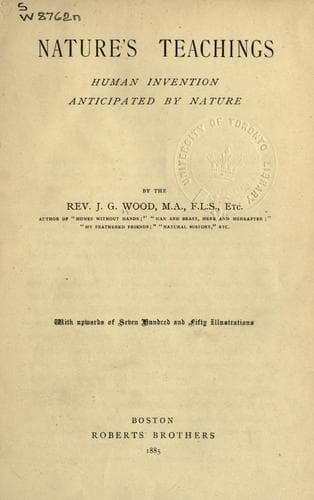
Nature's Teachings: Human Invention Anticipated by NatureWood, J. G. (John George)
History
Nature's Teachings: Human Invention Anticipated by Nature
Wood, J. G. (John George)
Inventions; Natural history
The reader will see that in the plumb-rule, the level, and the
spirit-level one single principle is employed, namely, the attraction of
matter towards the centre of the earth. In the two former instruments
this attraction gives a vertical line, and in the latter it gives a
horizontal line, but the principle is the same in both.
CALLIPERS.
[Illustration: JAWS OF SIALIS.]
[Illustration: CALLIPERS.]
We conclude the history of measuring tools with the Callipers. For
ordinary purposes, and upon a plane surface, the Compasses answer every
purpose. But there are various arts, especially sculpture, in which the
compasses, with their straight legs, are absolutely valueless, and their
place must be supplied by a differently shaped instrument. For example,
no ordinary compasses could measure the exact distance from the nostril
to the back of the head, or even touch two points at opposite sides of a
limb, and it is therefore necessary to have compasses with curved legs.
These are termed Callipers, and can be used on a plane as well as on a
rounded surface.
* * * * *
NATURAL Callipers are plentiful enough, and may be found extensively
among the insect tribes. There are, for example, the pincers of the
Earwig, which have already been described on page 259, and which are, in
the common species, formed exactly like the Callipers of the sculptor.
Then we have various insect jaws, especially those of the carnivorous
species, one of the most curious being the large insect which is shown
in the illustration, upon a very reduced scale. In the male the jaws are
exceedingly long and curved, as may be seen by reference to the
illustration. I have now before me a pair of sculptor’s callipers, and
the resemblance between them and the jaws of the Sialis is strangely
close, the curve being almost exactly the same in both cases.
The scientific name of this insect is _Sialis armata_, and it is a
native of Columbia.
OPTICS.
CHAPTER I.
THE MISSIONS OF HISTORY.--THE CAMERA OBSCURA.--LONG AND SHORT
SIGHT.--STEREOSCOPE AND PSEUDOSCOPE.--MULTIPLYING-GLASSES.
The Camera Obscura.--Telescopes, Microscopes, and Spectroscopes,
and their separate Objects.--Structure of the Camera Obscura.--The
Double Convex Lens.--Its Use as a Burning-glass.--The Meridian Gun
in Paris.--Signification of the Word “Focus.”--The Human Eye and
its Analogies to the Camera Obscura.--Forms of various
Lenses.--Long and Short Sight.--Their Causes and Means of
Remedy.--Alteration of Sight in the Diver.--Long and Short sighted
Spectacles.--The Eye of Birds.--Its beautiful
Structure.--Washing-glasses and the “Nictitating”
Membrane.--Combination of Images.--Natural Stereoscopes.--The
Pseudoscope and its Effects on an Object.--The
Multiplying-glass.--The Eight Eyes of the Spider and their
Arrangement.--The Seventy Thousand Eyes of the Butterfly.--Form of
the Facets.
Public-domain text, read in full here on John Shaqi.
Reviews
Reviews
No reviews yet
Be the first to share your thoughts on this work.
Elsewhere in the archive
Join the Discussion
Join the discussion
Sign in to leave a comment or review.
Sign InorCreate an account