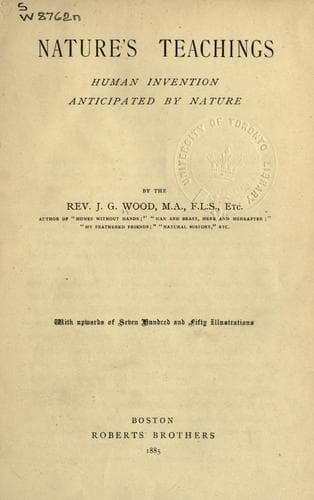
Nature's Teachings: Human Invention Anticipated by NatureWood, J. G. (John George)
History
Nature's Teachings: Human Invention Anticipated by Nature
Wood, J. G. (John George)
Inventions; Natural history
History seems to fall into natural divisions, and to write the records
of time in successive epochs, recording the advance of the human race.
Some of them have apparently disappeared except by the strange relics
which they have left behind, but though nothing is known of the men who
worked in these ancient times, they stamped their mark upon the earth,
and evidently left the world better than they found it.
A very admirable treatise on this subject has been written by the late
Rev. J. Smith, called the “Divine Drama of Creation.” In this work he
divides the progress of the human race into five acts, like those of a
drama. The first act is the Hebrew Mission, the second the Greek
Mission, the third the Roman Mission and the Middle Ages, the fourth the
National Mission, and the fifth the Universal Mission.
Certainly a scene of the last act is now in progress, and may be
entitled the Scientific Mission. The last hundred years have been indeed
the age of discovery, and, during that time, the life of civilised man
has been quite altered, so that practically his sojourn upon earth has
been doubled. Steam, with all its various applications, electricity, and
other kindred arts have become so intermingled with our lives, that it
is difficult to imagine what our state would be if we were suddenly and
utterly deprived of them. The loss to all would be incalculable, and not
the least of the losses would be that of ready communion with our
fellow-creatures.
Of these arts we will now take that which is named at the head of this
division of the book, and see how far it is a development of natural
facts.
THE CAMERA OBSCURA AND THE EYE.
I have already spoken of arts as being akin to each other. They are more
than this, and every day of the world’s progress teaches us that Art,
Science, and Manufacture are sisters, all born of one family, and all
depending mutually on each other.
Take, for example, our present theme--namely, Optics--and see how
dependent it is upon Manufacture and Art. Without the former, man could
not construct those beautiful telescopes, microscopes, spectroscopes, of
the present day, which are evidently but the precursors of instruments
which will work still greater marvels.
Public-domain text, read in full here on John Shaqi.
Reviews
Reviews
No reviews yet
Be the first to share your thoughts on this work.
Elsewhere in the archive
Join the Discussion
Join the discussion
Sign in to leave a comment or review.
Sign InorCreate an account