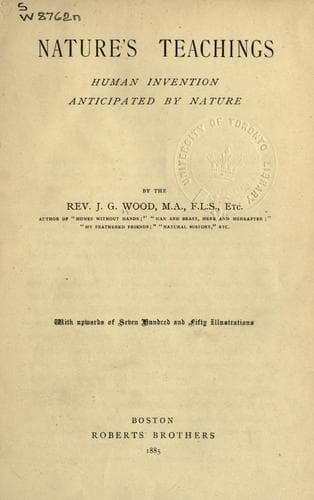
Nature's Teachings: Human Invention Anticipated by NatureWood, J. G. (John George)
History
Nature's Teachings: Human Invention Anticipated by Nature
Wood, J. G. (John George)
Inventions; Natural history
The first enables us to see solar systems without number, to which our
own, vast as it seems to us, is but as a grain of sand in the desert.
The next instrument makes revelations as marvellous of the infinitely
minute as does the telescope of the infinitely great, enabling us to see
living organizations so small that thirty-two millions could swim in a
cubic inch of water. The third, a comparatively modern instrument,
reveals the composition of objects, and can detect and register the
materials of which the sun and fixed stars are made, or detect an
adulteration in wine. It can adapt itself equally to the telescope and
microscope, and the very same instrument which will reveal the character
of an invisible gas in the Pole-star, when attached to the telescope,
can, when connected with the microscope, point out the presence of half
a corpuscle of blood where no other instrument could discover any trace
of it.
All these instruments, together with many others, will be described in
the present division of the work, and their analogies with Nature shown.
* * * * *
WE will now take the subject of the Camera Obscura, an instrument with
which the photographic apparatus of the present day has made most of us
familiar. As its action depends chiefly upon the glass, or lens, through
which the rays of light pass into the instrument, we will first explain
that.
A “lens” is a glass formed in such a manner that the rays of light which
pass through it either converge to a focus, or are dispersed, by means
of the law of refraction. Every one who has been photographed--and who
has not?--will remember that when the sitter has taken his position, the
photographer brings to bear upon him a circular glass fixed into a short
tube, and then looks through the instrument as if he were taking aim
with some species of firearm. It is no matter of wonder that when
savages see the photographic camera for the first time they are horribly
frightened, for there is really something weird-like in the appearance
of the lens thus presented.
Now, this lens is of the shape called “double convex,” both sides being
equally rounded, so that a section of it would be shaped very much like
a parenthesis (). The effect of this form of lens is to bring the rays
of light to a point at a given distance from the centre. This point is
called the “focus,” and is well known by means of the common
burning-glass, which will set fire to objects placed in its focus, while
itself remains quite cool.
I have seen lead pour down like water when placed in the focus of a
large burning-glass, and even the harder metals will yield to the power
of the sun’s rays when thus concentrated.
Public-domain text, read in full here on John Shaqi.
Reviews
Reviews
No reviews yet
Be the first to share your thoughts on this work.
Elsewhere in the archive
Join the Discussion
Join the discussion
Sign in to leave a comment or review.
Sign InorCreate an account