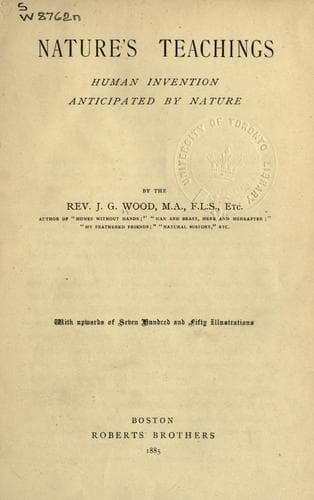
Nature's Teachings: Human Invention Anticipated by NatureWood, J. G. (John George)
History
Nature's Teachings: Human Invention Anticipated by Nature
Wood, J. G. (John George)
Inventions; Natural history
The form of multiplying-glass shown in the accompanying illustration is
probably familiar to most of my readers. It consists of a convex piece
of glass, cut into a number of facets, and showing in each facet a
distinct and separate image of the object to which it is directed. Now,
the compound eyes of insects are constructed on much the same
principle, except that the number of facets is infinitely more. Taking,
for example, the eyes of the Tortoise-shell Butterfly, we find that
there are about seventy thousand lenses or facets. Now, it is possible,
with care, to remove the eye from the insect, cleanse it, and arrange it
in ä microscope in such a way that objects can be seen through it. When
this is done, a separate image is seen in each facet, just as is the
case with the Multiplying-glass, only, as the facets are very much more
numerous, the effect is proportionately more striking.
[Illustration: INSECT EYE.]
[Illustration: TUMBLER.]
[Illustration: MULTIPLYING-GLASS.]
The reader may notice that the facets of the insect eye appear to be
hexagons as perfect as those of the honey-comb. This appearance is
probably due to the fact that each eye is covered with a convex plate of
glassy brightness and transparency, and that, when such objects are
viewed from the front, they appear to have hexagonal instead of rounded
outlines. A familiar example of this fact may be found in the glass
tumblers which are ornamented with rounded projections on their surface.
If a photograph of one of these tumblers be taken, the resemblance to
the hexagonal markings of the insect eye is so close that the tumbler
might easily be taken for the eye.
OPTICS.
CHAPTER II.
THE WATER TELESCOPE.--IRIS OF THE EYE.--MAGIC LANTERN.--THE
SPECTROSCOPE.--THE THAUMATROPE.
Limits to Sight in the Water.--Effect of a Ripple.--The Eyes under
Water.--The Water Telescope, its Structure and Mode of
Use.--Gyrinus, or Whirlwig-beetle, and its Double Set of Eyes.--The
Iris of the Eye, and its Double Set of Contractile
Fibres.--Cotterill’s Lock and its Structure.--The Magic Lantern and
its Principle.--Chinese Shadows.--Spectre of the Brocken.--An
Adventure in Wiltshire.--Effect of the Halo.--The
Spectroscope.--Its Structure explained.--A Star on fire.--Motes in
the Sunbeams.--Bessemer Steel made by aid of the
Spectroscope.--Absorption Bands.--Detection of Blood.--A Man’s Life
saved by the Spectroscope.--The Pocket Spectroscope.--The Rainbow,
Dewdrop, Soap-bubble, Opal, and Pearl.--The Thaumatrope.--Structure
of the Retina.--Complementary Colours.--The Zoetrope and
Chromatrope.--Wheel Animalcules and their Structure.--An Optical
Delusion.
THE WATER TELESCOPE.
Public-domain text, read in full here on John Shaqi.
Reviews
Reviews
No reviews yet
Be the first to share your thoughts on this work.
Elsewhere in the archive
Join the Discussion
Join the discussion
Sign in to leave a comment or review.
Sign InorCreate an account