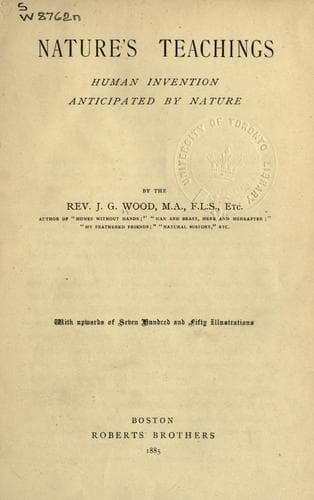
Nature's Teachings: Human Invention Anticipated by NatureWood, J. G. (John George)
History
Nature's Teachings: Human Invention Anticipated by Nature
Wood, J. G. (John George)
Inventions; Natural history
Every one who has watched the movements of the various creatures which
live below the surface of the water is aware how entirely dependent he
is on the unruffled character of that surface. No matter how clear the
water may be, the least ruffling of the surface will effectually shut
out all sight:--
“But if a stone the gentle sea divide,
Swift rippling circles rush on every side,
And glimmering fragments of a broken sun,
Banks, trees, and skies in thick disorder run.”
And there is an end of the observations. If, however, the eyes can
penetrate below the surface, the ruffling is of little consequence, so
long as the water is clear. Consequently, whenever the top of the bank
is sufficiently near the water, it is possible to continue the
observations by lying down, and immersing the head above the eyes. This
plan, however, is not a very comfortable one, although I have often
followed it on a windy day when the surface was too ruffled to permit of
vision in any other way.
Still, there is an instrument by which it is possible to counteract the
ruffle of the surface, and to see objects with tolerable plainness. This
is called the Water Telescope, and it is of very simple construction.
Like the ordinary telescope, it consists of a tube, but, instead of the
convex and concave lenses of that instrument, it has only a single glass
at one end, and that glass is perfectly plane.
[Illustration: WHIRLWIG-BEETLE.]
[Illustration: WATER TELESCOPE.]
When used, the eye is applied to the open end, and the glazed end
lowered into the water. The sight is then undisturbed by the ripple, and
the effect is the same as if the eyes themselves were lowered beneath
the surface.
It is much used in looking for shells, sea-urchins, and other creatures
which live in the bed of the sea.
* * * * *
IN the insect world we have an example of a natural Water Telescope. I
do not say that the inventor of the Water Telescope took his idea from
the insect, but the reader will see that he might very well have done
so.
There are sundry little beetles popularly called Whirlwigs or
Whirligigs, and scientifically known by the name of _Gyrinus_. All these
names allude to the insect’s habit of whirling about on the surface of
the water, with a movement which seems ceaseless and untiring. Allusion
has already been made to the Whirlwigs on page 22.
Public-domain text, read in full here on John Shaqi.
Reviews
Reviews
No reviews yet
Be the first to share your thoughts on this work.
Elsewhere in the archive
Join the Discussion
Join the discussion
Sign in to leave a comment or review.
Sign InorCreate an account