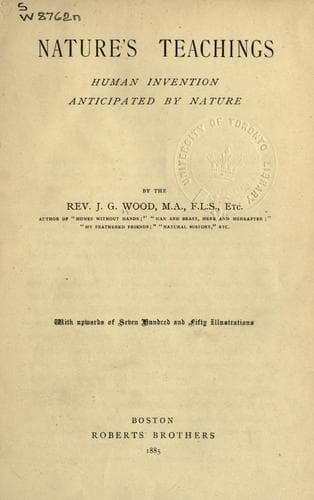
Nature's Teachings: Human Invention Anticipated by NatureWood, J. G. (John George)
History
Nature's Teachings: Human Invention Anticipated by Nature
Wood, J. G. (John George)
Inventions; Natural history
During the month of May, 1866, one of the stars in the Northern Crown
(_Corona Borealis_) was seen to undergo a rapid change. It was
originally one of the tenth magnitude, but in a short time increased in
size and brilliancy until it nearly equalled Sirius, Capella, or Vega.
It remained bright for some time, and then rapidly faded until it
resumed its former size.
How this change was effected we never should have known but for the
Spectroscope. No sooner, however, was this instrument pointed at the
star than there appeared in the spectrum the three well-known
lines--red, green, and violet--which denote burning hydrogen. There was
no doubt on the matter, and the Spectroscope showed us that we were
witnessing a conflagration the like of which was never seen or scarcely
imagined.
[Illustration: RAINBOW.]
Supposing our sun, which is known to be one of the stars, and about
which there are vast volumes of hydrogen gas, were to blaze out in a
similar manner, the result would be that the whole of the planets would
be consumed in a few seconds, and converted into gases. In an instant
every living thing would be swept off the surface of the earth by this
fearful heat, and, as Mr. Roscoe says, “our solid globe would be
dissipated in vapour almost as soon as drops of water in a furnace.” So,
as Mr. Huggins observes, the old nursery rhyme,--
“Twinkle, twinkle, little star,
How I wonder what you are,”--
is no longer tenable, for we really do know the composition of the
stars.
The Spectroscope not only tells us the substance of which the sun and
the most distant stars are made, but gives us the same information about
the “gay motes that people the sunbeam.” It tells us that they are
common salt in very minute particles. They have been dashed into the air
by the winds as spray, and then dispersed over the whole globe. This is
one reason why we have so much salt in our bodies, and why the blood and
the tears are so salt.
* * * * *
IT is also applied to the arts. The well-known Bessemer process consists
in pouring melted iron into a peculiarly shaped vessel called a
“converter,” and blowing air through it for the purpose of burning out
the carbon. From the mouth of the converter issues a volume of
magnificent flames, and at a certain moment the skilled workman who
directs the process inverts the vessel and pours out the steel. A very
few seconds too soon or too late would spoil the whole of the metal, in
the former case it being simply brittle cast-iron; and, in the second,
becoming so thick that it could not be poured out.
Only a few workmen could judge rightly the exact point at which to shut
off the air-blast. They watched the flame, and by some change in it, too
slight to be noticed by any except experienced eyes, knew the moment
when the iron was converted into steel.
Public-domain text, read in full here on John Shaqi.
Reviews
Reviews
No reviews yet
Be the first to share your thoughts on this work.
Elsewhere in the archive
Join the Discussion
Join the discussion
Sign in to leave a comment or review.
Sign InorCreate an account