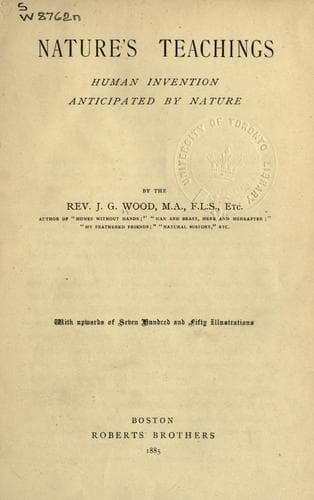
Nature's Teachings: Human Invention Anticipated by NatureWood, J. G. (John George)
History
Nature's Teachings: Human Invention Anticipated by Nature
Wood, J. G. (John George)
Inventions; Natural history
Wishing to show a friend the extraordinary sight of a Brocken Spectre, I
took him up the hill on a misty day like that which has been briefly
described. According to surmise, two spectres appeared instead of one,
but the halo was not doubled as well as the shadow. I could see my
friend’s shadow, and he could see mine. But, although the halo was as
bright as before, each of us could only see it encircling his own head.
We stood as close to each other as we could, we moved apart as far as
the nearly conical top of the hill would allow, and in both cases each
of us could only see his own halo.
Perhaps the reader may remember the wonderful spectre-scene drawn by Mr.
Whymper, and viewed from the Matterhorn just after the accident which
had killed several of his companions in the ascent of the hitherto
impregnable peak. In the mist there suddenly appeared three vast dark
crosses enclosed in an oval. Considering the highly-strung nerves of the
survivors, it was no wonder that they were all shaken by such an
appearance, and that the guides were for a time too frightened to
proceed.
THE SPECTROSCOPE.
Next we come to one of the most astonishing and beautiful optical
instruments ever made by the hand of man. It is called the Spectroscope,
because it deals with a certain arrangement of rays which is called a
“spectrum.” Many years ago Newton discovered the cause of the lovely
colours which deck the rainbow, and the fact that, by passing a ray of
white light through a prism, it was decomposed into seven colours, which
invariably came in the following order--Red, Orange, Yellow, Green,
Blue, Indigo, and Violet. He also discovered that, by looking at that
coloured band through another prism arranged in a different manner, the
decomposed rays were again brought together, and white light was the
result.
Newton had thrown the light on the prism through a round hole, but some
time afterwards Dr. Wollaston employed a narrow slit for the purpose,
and then found that the spectrum was traversed by dark lines which never
changed their places. On these lines depend all the discoveries that
have been made by the aid of the Spectroscope. The chief of them are
designated by the letters of the alphabet. (See page 300.)
It was soon found out that if burning gases were viewed with the
Spectroscope, lines were still seen, but they were bright instead of
dark, and that they invariably occupied the place of one or more of the
dark lines shown by the spectrum of sunlight. Then it was discovered
that these burning gases absorbed or stopped out the light in the solar
spectrum, and from that moment the science rapidly advanced.
At the present day the Spectroscope not only determines the metals which
exist in the sun, but also those of the fixed stars. It even analyzes
the constitution of double stars, and shows the reason why one star
should be red and the other green.
One of the most astonishing discoveries in astronomy was due to the
Spectroscope.
Public-domain text, read in full here on John Shaqi.
Reviews
Reviews
No reviews yet
Be the first to share your thoughts on this work.
Elsewhere in the archive
Join the Discussion
Join the discussion
Sign in to leave a comment or review.
Sign InorCreate an account