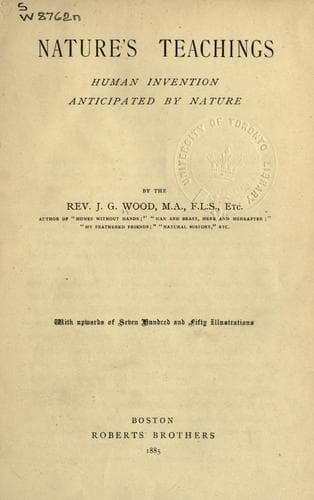
Nature's Teachings: Human Invention Anticipated by NatureWood, J. G. (John George)
History
Nature's Teachings: Human Invention Anticipated by Nature
Wood, J. G. (John George)
Inventions; Natural history
There is not a dewdrop which is not a miniature Spectroscope, as it
glitters with its wondrous iridescence in the rays of the rising sun;
there is not an opal with its shifting hues, nor the splendour of the
soap-bubble, nor the nacre of the common river mussel or the ormer
shell, which does not owe its beauty to the same principles which govern
the Spectroscope. Every green leaf, and blue or pink or yellow petal,
every varying tint of the mackerel sky, every blaze of sunset and
bluegrey of sunrise, owes its beauty to those wondrous laws of light
which had been hidden for so many centuries, until they were unveiled by
the simple prism of the Spectroscope. As in so many instances, the
revelation lay concealed until the coming of the revealer, whose
inspired hand raised the dark veil of centuries.
THE THAUMATROPE.
Middle-aged persons will recollect that since the days of their
childhood a great variety of optical apparatus has been invented ending
in the word “trope.” This is a Greek word, signifying to turn, and is
given to the instruments because they revolve.
All these toys--and they may some day become more than toys--depend on a
curious property of the human eye. The reader will remember that in the
description of the human eye, as compared with the camera obscura as
applied to photography, it was mentioned that the image was thrown from
the front to the back, and in the one case was received on a naturally
sensitive membrane, and in the other on a film rendered artificially
sensitive by chemical means. This membrane is called the “retina,”
because it not only receives the impression, but retains it for some
little time after the object is removed. It has been calculated that the
duration of the image is about the eighth part of a second.
Thus the eyelids are perpetually and unconsciously closing and opening
with a rapid movement, popularly called “winking.” This movement is for
the purpose of cleansing the eyeball, and, were it not for the
image-retaining power of the retina, we should pass a considerable part
of our time in absolute darkness. As it is, the impression of external
objects on the retina lasts longer than the time occupied in winking,
and, in consequence, we are not conscious that any interval of darkness
has elapsed.
Again, when we have been looking steadfastly at an object, and then move
our eyes, the image of that object is seen in the new focus; and it is
worthy of notice that such object is always seen in its “complementary”
colour. For example, if we have been looking at a scarlet spot, and
suddenly move our eyes, we shall see a spot exactly similar in size and
shape, but of green.
Public-domain text, read in full here on John Shaqi.
Reviews
Reviews
No reviews yet
Be the first to share your thoughts on this work.
Elsewhere in the archive
Join the Discussion
Join the discussion
Sign in to leave a comment or review.
Sign InorCreate an account