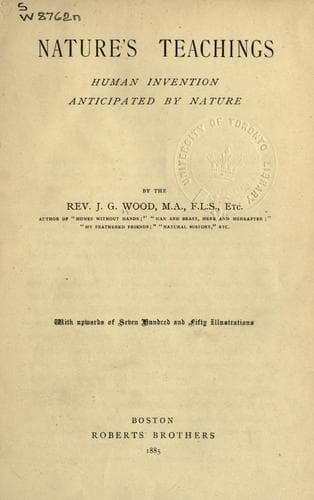
Nature's Teachings: Human Invention Anticipated by NatureWood, J. G. (John George)
History
Nature's Teachings: Human Invention Anticipated by Nature
Wood, J. G. (John George)
Inventions; Natural history
I well remember that when I was a boy I was reading with almost feverish
anxiety the green handbill of a travelling circus, to which I hoped that
I might be allowed to attend. Having finished it, I asked for some
note-paper, for the purpose of putting my request in writing, but, to my
astonishment, mixed, perhaps, with a little irritation, all the paper
supplied to me was of a bright pink. For a time no arguments could
convince me that the paper was really white, until by degrees the pink
hue became paler and paler, and the paper assumed its normal whiteness.
The fact was, that the eye had become saturated with the green--_i.e._
the blue and yellow rays--and could see nothing but their complementary
colour, which was pink.
A good example of this property may be found in a lighted stick, which,
if rapidly whirled round, appears to form a continuous circle of fire.
The reason of this is, that the impression made on the retina by the
fiery point does not cease until the stick has again come round in its
course.
Then there are those well-known chromatic tops, in which are inserted
pieces of bent wire. When the top is spun these pieces of wire assume
exactly the appearance of transparent jugs, vases, glasses, and similar
articles. A very pretty illustration of this principle is given by a
little machine, which is made to revolve rapidly by means of a
multiplying wheel.
Upon its surface are fixed little pins, with polished globular steel
heads, and, when the handle is turned, these heads form the most
beautiful and intricate figures with exact accuracy.
Another toy, called the Thaumatrope, or Wonder-turner, is equally
ingenious and beautiful, and is sufficiently simple to be made by any
one with a slight knowledge of drawing. A disc of white cardboard is
cut, and upon each side of it is portrayed some object. If the disc be
caused to revolve rapidly, these two subjects will be seen at the same
time, the image of each being held on the retina long enough to allow
the other to take its place.
Some very beautiful combinations may be made by means of this
instrument. For example, a horse may be on one side, and a man on the
other, and, by spinning the disc, the man will be seen mounted on the
horse. Then we may have a boat on one side, and a rower with his oars on
the other. Similarly a mouse can be put into a trap, or a bird into a
cage.
The reader must remember that these subjects must be drawn as if they
were upside down with regard to each other, so that the man who is to
ride the horse is drawn as if he were standing on his head, and the
mouse which is to enter the trap looks as if it were lying on its back.
The most simple manner of spinning the disc is by means of two threads,
each being inserted near the edge of the disc, and exactly opposite each
other.
Public-domain text, read in full here on John Shaqi.
Reviews
Reviews
No reviews yet
Be the first to share your thoughts on this work.
Elsewhere in the archive
Join the Discussion
Join the discussion
Sign in to leave a comment or review.
Sign InorCreate an account