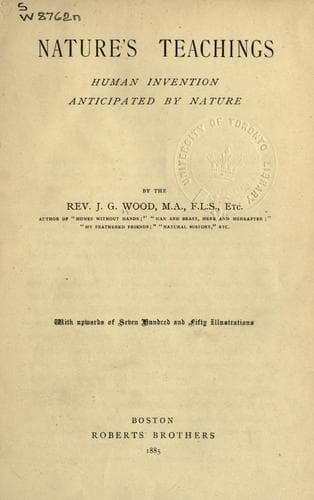
Nature's Teachings: Human Invention Anticipated by NatureWood, J. G. (John George)
History
Nature's Teachings: Human Invention Anticipated by Nature
Wood, J. G. (John George)
Inventions; Natural history
Passing to the vegetable world, we find a familiar example of this
structure in the common Wheat Straw. The ripe ear is so heavy, when
compared with the amount of material which can be spared to carry it,
that if the stalk were solid it would give way under the mere weight of
the ear. Moreover, the full-grown corn has to endure much additional
weight when wetted with rain, and to resist much additional force when
bowed by the wind, so that a slight and solid stalk would be quite
inadequate to the task of supporting the ear.
The material of the stalk is therefore utilised in a different manner,
being formed into a hollow cylinder, the exterior of which is coated
with a very thin shell of flint, or “silex” as it is scientifically
termed. The result of this structure is that the stem possesses
strength, lightness, and elasticity, so as to be equal to the burden
which is laid upon it.
Then there is the common Bamboo, which is little more than a magnified
straw, being constructed in much the same manner, and possessing almost
the same constituents of vegetable matter and silex.
Perhaps the most extraordinary of the tubal system is to be found in the
remarkable plant of Guiana called by the natives Ourah, and
scientifically known by the name of _Arundinaria Schomburgkii_. Like the
bamboo, it grows in clusters, and has a feathery top, which waves about
in the breeze. But, instead of decreasing gradually in size from the
base upwards, the Ourah, although it runs to some fifty feet in height,
is nowhere more than half an inch in diameter. The first joint is about
sixteen feet in length, and uniform in diameter throughout.
It is scarcely thicker than ordinary pasteboard, and yet so strong and
elastic is it, that it can sustain with ease the weight and strain of
its feathery top as it blows about in the breeze. The natives of certain
parts of Guiana use this reed as a blow-gun, and I have a specimen,
presented to me by the late Mr. Waterton, which is eleven feet in
length.
So the reader will see that when engineers found that hollow iron beams
were not only lighter, but stronger than solid beams, they were simply
copying the hollow beams formed by Nature thousands of years ago.
* * * * *
ANOTHER great improvement in ship-building now comes before us.
We have already seen that the earliest boats were merely hollowed logs,
just as Robinson Crusoe is represented to have made. But these had many
disadvantages. They were always too heavy. They were liable to split, on
account of flaws in the wood, and if a large vessel were needed, it was
difficult to find a tree sufficiently large, or to get it down to the
water when finished.
Public-domain text, read in full here on John Shaqi.
Reviews
Reviews
No reviews yet
Be the first to share your thoughts on this work.
Join the Discussion
Join the discussion
Sign in to leave a comment or review.
Sign InorCreate an account