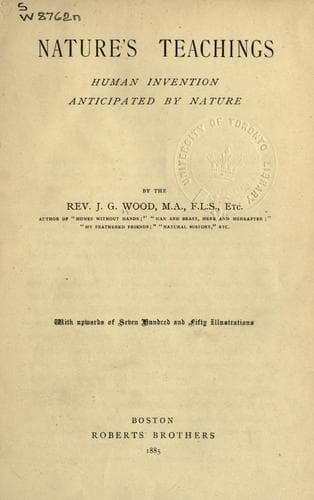
Nature's Teachings: Human Invention Anticipated by NatureWood, J. G. (John George)
History
Nature's Teachings: Human Invention Anticipated by Nature
Wood, J. G. (John George)
Inventions; Natural history
These teeth and grooves would of themselves make a very efficient
filter, but they are further aided by the tongue. This is thick, fleshy,
and very mobile; so much so, indeed, that when the mouth is opened the
tongue is automatically thrust forward. The edges of the tongue are,
like those of the mandibles, furnished with a filtering apparatus.
Instead, however, of being horny and stiff like those of the mandibles,
they are membranous and exceedingly delicate. Indeed, in order to see
them properly, it is necessary to place the tongue under water, so that
the membranous filaments shall be floated apart instead of clinging
together by their own weight.
The whole of this apparatus is abundantly supplied with nerves, and is
evidently a most exquisite instrument of touch. The reader will now
understand the peculiar movements of a duck’s beak while feeding.
Although the bird can and does eat solid food, such as barley, and, by
reason of its superior width of beak, will very much defraud the poultry
in a yard where ducks and hens are kept together, it is chiefly fitted
for extracting nourishment from water, and will find abundant
subsistence where a hen would die of starvation.
When the beak is plunged into the water, the mandibles are rapidly
opened and shut, the tongue incessantly working backwards and forwards
between them. Consequently, not only are the solid parts of the water
strained between the comb of the upper beak and the grooves of the
lower, but they undergo a further sifting or filtering from the delicate
fibrils which fringe the edge of the tongue.
* * * * *
ANOTHER familiar example of the Filter is to be found in the jaw of the
Greenland Whale. In this animal, as well as in its congeners, the
“whalebone,” or “baleen,” as it is more properly called, is so formed
that it allows liquids to pass through it, while it retains solids.
Feeding as it does upon small marine matters, it would starve but for
the filtering power of the baleen, which enables the animal to take into
its vast mouth the sea-water with its inhabitants, and to expel the
water through the plates and fibres of the baleen, while retaining the
animals.
The process of filtering, as well as the structure of the baleen, is so
familiar that it does not need further description.
* * * * *
WE will now proceed to another filter, which is used in the air, and not
in water, namely, the Mouth-guard or Respirator of the fork-grinder.
Public-domain text, read in full here on John Shaqi.
Reviews
Reviews
No reviews yet
Be the first to share your thoughts on this work.
Elsewhere in the archive
Join the Discussion
Join the discussion
Sign in to leave a comment or review.
Sign InorCreate an account