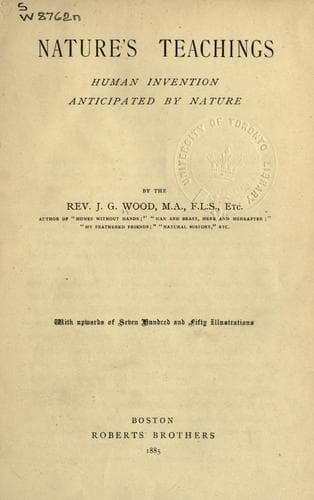
Nature's Teachings: Human Invention Anticipated by NatureWood, J. G. (John George)
History
Nature's Teachings: Human Invention Anticipated by Nature
Wood, J. G. (John George)
Inventions; Natural history
There is, perhaps, no trade which is more destructive of human life than
that of the fork-grinder was until the peculiar respirator was made
obligatory. The minute particles of steel thrown off by the grindstone
fill the air, and were necessarily inhaled. Now, the human lungs are
capable of enduring very bad treatment, but the introduction of
steel-dust into them is more than they can bear. Consequently the
duration of human life was very short, consumption almost invariably
setting in at an early age, and carrying off the men before they had
achieved middle age.
Nor did the mischief end there. It was bad enough that life should be
shortened, but far worse that it should be wasted, as was mostly the
case. The men, knowing what their fate must be, were simply reckless,
and plunged into all kinds of debauchery, under the plea of “a short
life and a merry one.” They knew no better, and could scarcely be blamed
for their mode of living. And, as a matter of course, each succeeding
generation was worse, smaller, and feebler than the preceding.
Then there came the invention of the Magnetic Respirator, by which the
fork-grinder’s trade was rendered as healthy as any other. It was made
of steel-wire gauze, and magnetised, so that the floating particles of
steel were not only stopped in their progress to the lungs, but arrested
by the magnetism, and, so to speak, taken prisoners by it.
Even a well-made respirator of several layers, like those which are used
by persons suffering from weak lungs, would have been useful, but the
addition of magnetism doubled the efficacy while greatly diminishing the
cost, a single layer of wire being quite adequate to the office, and
was, in fact, quite a stroke of genius.
The value of this invention is at once shown by the many complaints
which the workmen made when the Respirator was first introduced. They
complained that the apertures of the Respirator became so choked that
they could not breathe. This was perfectly true, but the complaint
showed the real value of the instrument.
[Illustration: SPIRACLE OF FLY.]
[Illustration: RESPIRATOR OF FORK-GRINDER.]
It was necessary for the workmen, every now and then, to clear off the
innumerable particles of steel which adhered to the magnetised wires,
and impeded respiration. But they never seemed to realise the fact that,
if it had not been for these wires, all the particles would have been
drawn into the lungs, and gradually choked them up, brought on
inflammation, and extinguished their life altogether. And, with the
usual repugnance to new ideas which is inherent in undeveloped minds,
the men stoutly resisted the introduction of the Respirator, and did
their best to reject an invention which doubled the length of their
lives, and enabled them to find long happiness in the world instead of
brief pleasure ended by sure and painful death.
* * * * *
NOW, we will see how the principle of the Respirator is carried out in
Nature.
Public-domain text, read in full here on John Shaqi.
Reviews
Reviews
No reviews yet
Be the first to share your thoughts on this work.
Elsewhere in the archive
Join the Discussion
Join the discussion
Sign in to leave a comment or review.
Sign InorCreate an account