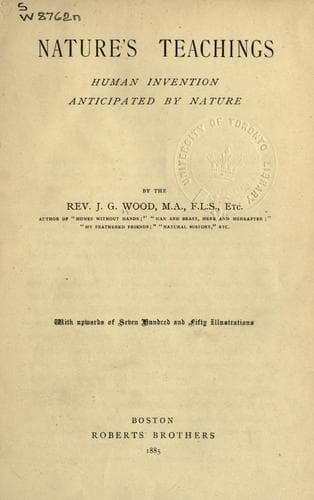
Nature's Teachings: Human Invention Anticipated by NatureWood, J. G. (John George)
History
Nature's Teachings: Human Invention Anticipated by Nature
Wood, J. G. (John George)
Inventions; Natural history
These egg-groups are plentiful enough, if the observer only knows where
to look for them. I have several of them in my collection, and have
found that nearly every one who sees them for the first time takes them
for mosses. I never myself saw the pretty insect lay its eggs, and for
the description am indebted to Mr. A. G. Butler, of the British Museum,
who has kept them and watched their habits.
The objects on either side of the Lace-wing Fly’s eggs are egg-groups of
certain spiders, suspended by threads from branches.
* * * * *
A STILL more remarkable instance of unconscious imitation may be found
in the two objects in the accompanying illustration. It is hardly
necessary to say that the right-hand figure represents a portion of the
arrangement by which a butcher hangs up his meat out of harm’s way until
it is wanted.
The hooks in question are simply formed into a double curve, like the
letter S, and can be slid along the horizontal bar without any danger of
falling.
Now, in the common Sloth we have an exact prototype of the butcher’s
hook. The Sloth passes the whole of its life in the remarkable attitude
which is shown in the illustration. It lives among the branches--not on
them, but under them--its claws being long and curved, just like a
butcher’s hook. I have often watched the animal traversing the branches,
and have been greatly struck with the accurately picturesque description
of the late Mr. Waterton, who was the first to discover the real
character of the Sloth.
It was he who found out that the previous ideas as to the Sloth’s mode
of life were utterly erroneous, and that, instead of being a sort of
bungle, the Sloth was as perfect in its way, and as well fitted for its
mode of life, as the lion or tiger. He discovered that the animal
always hung from the branches, as shown in the illustration. In fact, as
Sydney Smith remarked in his witty review of “Waterton’s Wanderings,”
the Sloth passes his whole life in suspense, “like a young clergyman
distantly related to a bishop.”
[Illustration: SLOTH.]
[Illustration: BUTCHERS’ HOOKS.]
* * * * *
THERE are many other creatures which afford similar examples, though
perhaps none are so striking as the Sloth.
For instance, there are the whole tribe of Bats, which, by means of the
curved claws attached to their hind-feet, can hang themselves head
downwards in the open air, and even swing in wind, without the least
fear of falling.
USEFUL ARTS.
CHAPTER VIII.
DOMESTIC COMFORT.
Public-domain text, read in full here on John Shaqi.
Reviews
Reviews
No reviews yet
Be the first to share your thoughts on this work.
Elsewhere in the archive
Join the Discussion
Join the discussion
Sign in to leave a comment or review.
Sign InorCreate an account