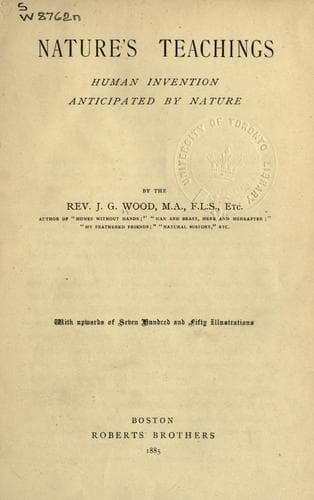
Nature's Teachings: Human Invention Anticipated by NatureWood, J. G. (John George)
History
Nature's Teachings: Human Invention Anticipated by Nature
Wood, J. G. (John George)
Inventions; Natural history
We cannot well have our bedclothes--indeed, any kind of clothes--without
the use of needles and thread. The simplest form of sewing is that which
is adopted in many parts of the world, namely, of boring holes and
pushing a thread through them, no eye being required in the needle. In
this way the Kafirs of Southern Africa and the Esquimaux of the Polar
regions make their beautiful garments of skins. I have for many years
had in constant use two South African cloaks, or karosses, and one made
by the natives of Vancouver’s Island, and they are now as good as they
were when they were first given to me. Naturally, such a mode of sewing
consumes much time, but, as time is not of the least value to these
native furriers, no harm is done, and the junctions of the different
skins is absolutely perfect. Even where holes have been made in the
skin, the native furrier has supplied their places with circular pieces
so neatly inserted, that on the outside not a trace of the junction is
visible, and even the very set of the hairs is preserved.
Our very modern needles, with their eyes which carry the thread, are but
a modification of the original plan of boring holes, and pushing the
thread through them.
* * * * *
NATURE has a singular parallel in the case of the Tailor-bird, which
sews leaves together by their edges, and makes its nest inside them. It
acts exactly like one of our own shoemakers, using its slender and
sharply pointed beak in lieu of the awl, and employing a slight but
strong vegetable fibre in place of the “waxed end” of the shoemaker, or
the sinew-thread of the Kafir.
In the illustration an ordinary needle and thread are seen on the
right-hand side, and on the left are two nests of the Tailor-bird, taken
from specimens in the British Museum.
[Illustration: TAILOR-BIRDS AND NESTS.]
[Illustration: SEWING CLOTH.]
The mode of sewing is strangely like that which is employed by the
uncivilised furriers who have been described, and much superior to that
which is seen in many other parts of the world. For example, I have a
West African quiver made of hide sewn together with stitches infinitely
more clumsy than those of the Tailor-bird.
The reader will also remark that I might have placed this singular nest
in the category of beds, on account of the soft and warm lining on which
the young repose. I have, however, thought that it more properly belongs
to the present division of the subject.
* * * * *
SOMETIMES we require a temporary as well as a permanent shelter from the
elements, and procure it by means of the Umbrella.
Public-domain text, read in full here on John Shaqi.
Reviews
Reviews
No reviews yet
Be the first to share your thoughts on this work.
Elsewhere in the archive
Join the Discussion
Join the discussion
Sign in to leave a comment or review.
Sign InorCreate an account