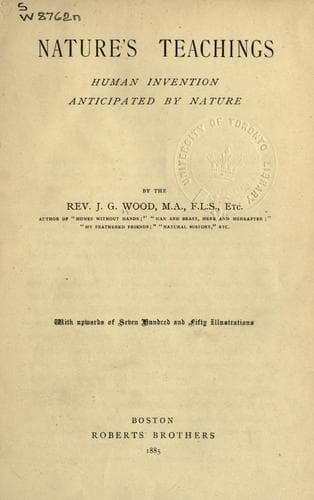
Nature's Teachings: Human Invention Anticipated by NatureWood, J. G. (John George)
History
Nature's Teachings: Human Invention Anticipated by Nature
Wood, J. G. (John George)
Inventions; Natural history
In many countries, especially those where the climate is hot, the
Umbrella is almost exclusively used, as, indeed, its name denotes, to
preserve its owner from the direct sunbeams, and is, in fact, the
“parasol” of our European ladies. It also is a mark of dignity, the
amount and quality of its decorations indicating rank, even though the
man who sits under its shade is clothed in a modest cotton cloth wrapped
round his waist.
For the purpose of shielding the bearer from the sun the Umbrella was
first introduced, and the introducer incurred the obloquy usual in such
cases. Now, however, the Umbrella has by common consent become a
defence against rain and snow, the male sex leaving the parasol to the
gentler half of creation, and submitting themselves to the chance of a
sunstroke.
* * * * *
WE all know the ingenious Umbrellas of Africa, China, Japan, Siam, &c.;
but there are few persons who know that a common magnifying-glass will
disclose thousands of beautifully perfect umbrellas on the leaf of the
Rosemary.
[Illustration: HAIRS OF ROSEMARY.]
[Illustration: UMBRELLA.]
Pinch the Rosemary-leaf between the fingers, and a strong and peculiar
perfume is evolved, just as when the peel of the orange is squeezed. The
reason is the same in both cases, namely, the presence of multitudes of
spherical vessels which contain their essential oil, secreted by the
plant.
In the orange they are sunk below the surface of the skin, and are
protected by it; but in the Rosemary they stand on slight footstalks, as
shown in the illustration.
Being very delicate, and liable to be broken at the least touch, they
are protected by a series of curiously formed hairs, which extend over
them exactly as would an umbrella, and defend them from the elements.
The surface of a Rosemary-leaf affords a singularly beautiful sight,
even with a common magnifying-glass, the tiny perfume-globes gleaming
like little pearls in the broken lights that shine through the
umbrella-like hairs.
* * * * *
NOW we come to another part of domestic life, namely, Servants.
There is a diversity of ideas on this subject, as we know by the
various discussions respecting “lady-helps” and “gentlemen-helps,” which
bid fair to initiate a revolution in domestic life. Servants are
sometimes called the greatest plagues in life, but it is difficult to
see what could be done without them.
Then there is the complaint that servants are not what they used to
be--the faithful retainers of the household, and considering themselves
members of it. Perhaps not, but I have had experience of several
faithful retainers, and invariably found them to be unmitigated tyrants,
assuming power, repudiating responsibility, and being practically the
master or mistress of the household.
Then we come to the great question of slavery in its various bearings.
Public-domain text, read in full here on John Shaqi.
Reviews
Reviews
No reviews yet
Be the first to share your thoughts on this work.
Elsewhere in the archive
Join the Discussion
Join the discussion
Sign in to leave a comment or review.
Sign InorCreate an account